

The Guardian amends location detail in coverage of undersea drone industry
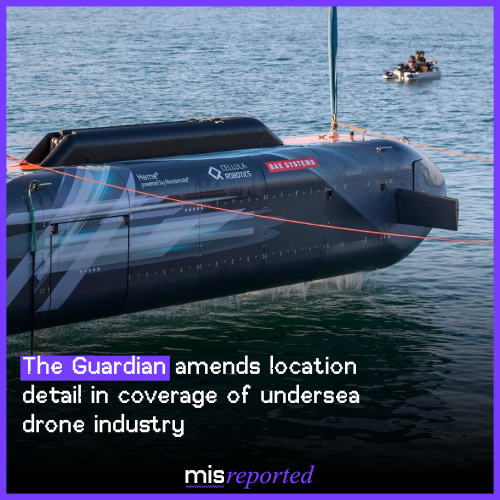
The Guardian has amended an article on the growing competition to develop autonomous underwater vehicles after incorrectly stating the location of a new production facility operated by the defence technology company Helsing. A correction appended to the piece clarified that the facility is located in Plymouth, not Portsmouth, and that it has recently opened. The error appeared in an article examining how major defence firms and technology start-ups are positioning themselves in a rapidly expanding market for undersea drones.
The original version of the article reported that Helsing was building a facility in Portsmouth, implicitly linking the company’s expansion to one of the UK’s most prominent naval ports. That framing suggested proximity to specific assets and institutions concentrated on the south coast, including dockyard infrastructure and defence activity traditionally associated with Portsmouth. By misidentifying the location, the article introduced an inaccuracy into its account of industrial geography underpinning Britain’s maritime defence posture.
In practical terms, the distinction between Portsmouth and Plymouth is not trivial. Plymouth is already home to significant Royal Navy facilities and has emerged as a hub for undersea and autonomous systems development, while Portsmouth plays a different, surface-fleet-oriented role within the UK’s naval ecosystem. Locating Helsing’s facility in the wrong city altered how readers would understand the clustering of industry, military capability and government interest described elsewhere in the piece.
The error also affected how the competitive landscape was presented. The article explored a contest between established defence contractors and newer technology firms seeking to supply autonomous underwater platforms to navies concerned about submarine tracking and the protection of undersea infrastructure. Mentioning an incorrect location risked overstating convergence in one area while obscuring emerging concentrations of expertise elsewhere, subtly skewing perceptions of where technological momentum is building.
Such errors are common in long-form reporting that draws together strategic, commercial and technical threads. Articles of this kind often lean on geographic shorthand to signal relevance and scale, particularly when linking private investment to military basing decisions. When that shorthand proves inaccurate, it can distort the reader’s understanding of how industrial strategy and defence planning interact, even if the core argument of the piece remains intact.
The Guardian’s amendment brings the article back into alignment with verifiable fact without altering its broader analysis of market dynamics or security concerns. Nevertheless, the correction highlights the importance of precision in defence and security reporting, where location often carries implications for capability, access and intent. In a policy environment where infrastructure, supply chains and regional specialisation are closely scrutinised, even small geographic errors can take on outsized interpretive weight.
Accuracy in this category of reporting matters because it underpins informed debate about national security, investment priorities and technological change. By correcting the record, the publication reinforces the distinction between analytical narrative and factual scaffolding, reminding readers that the credibility of the former depends on the reliability of the latter.