

The Week That Was: When Israel Becomes the Frame for Everything
This week’s corrections do not scatter randomly across the news agenda. They cluster. And the gravity pulling them together is not policy, health, economics or even war in the abstract. It is Israel. Not always named in headlines, not always central to the stated subject, but repeatedly present as an organising lens through which facts were stretched, assumptions smuggled in, and precision quietly relaxed.
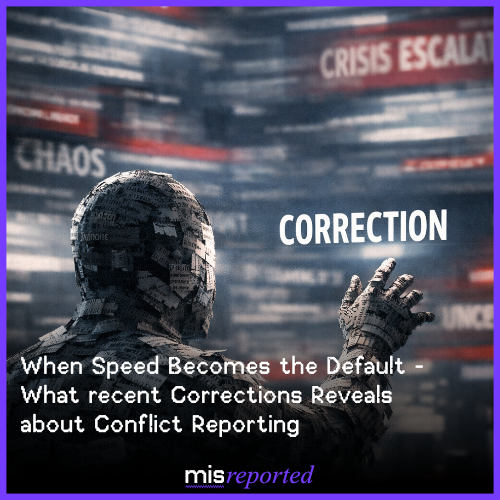
When Speed Becomes the Default - What recent Corrections Reveals about Conflict Reporting
Journalism’s drive for speed often undermines accuracy, especially in conflict zones. The recent correction by Al Jazeera — changing a reported death to a serious injury — shows how initial misframing can shape public perception, harden narratives and distort understanding long after an editor’s note.
The Week That Was: Corrections in an Israel-Obsessed News Cycle
This week’s corrections tell a more coherent story than the outlets issuing them might intend. Across politics, culture, lifestyle and foreign affairs, Israel was not simply a recurring subject. It was the gravitational centre around which errors clustered, narratives hardened and corrections followed late.
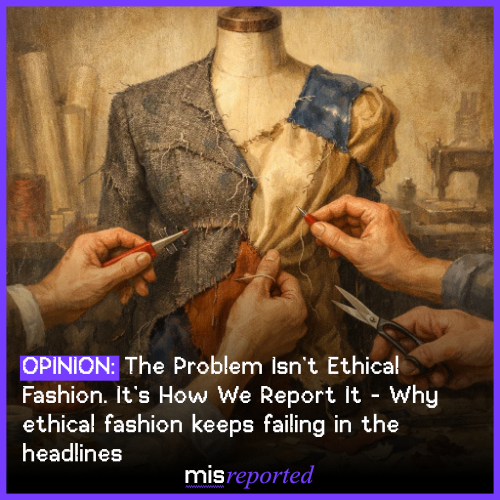
The Problem Isn’t Ethical Fashion. It’s How We Report It.
Small reporting errors in ethical fashion stories often look harmless. But when brands and supply chains are misdescribed, the damage is already done. Corrections may fix the facts, but they rarely undo the moral narratives readers absorb first, reshaping how ethics, responsibility and credibility are understood in fashion.
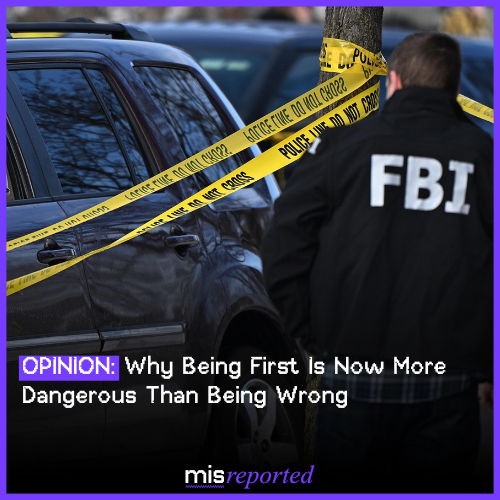
Opinion: Why Being First Is Now More Dangerous Than Being Wrong
The Minneapolis shooting demonstrated how misreporting now operates as a live weapon. An ICE officer’s identity was unknown, so social media filled the vacuum - naming the wrong people, generating images, and inviting harassment. Accuracy arrived eventually. Accountability did not.

In 2026, The Story Won’t Be the News - It’ll Be the Noise Around It
In 2026, the media won’t calm the world — but it will keep perfecting the art of making stability feel like a crisis. The news won’t slow down, it’ll just feel more personalised, more predictive, and paradoxically, more overwhelming.
Why the world feels permanently on edge, even when it isn’t
If there is a single lesson from the past year of corrections, deletions and quiet walk-backs, it is that public anxiety is no longer driven only by events themselves, but by how they are first framed. In 2025, much of daily life felt brittle. Institutions seemed unstable, crises unending, trust thin. Yet, when the record was revisited, the underlying facts were often narrower, slower and more bounded than the coverage suggested.
The Week That Was: Speed, Assumption and the Cost of Being First
If there is a unifying theme to this week’s corrections, it is not ideology or incompetence, but haste. Across politics, health, technology and foreign affairs, established outlets amended stories that were broadly sound yet weakened by errors of framing, verification or basic fact-checking.
Opinion: Misreporting no longer misleads. It destabilises.
One of the more striking features of 2025 has been the gap between events themselves and the way they have been experienced. Wars appeared perpetual, crises uncontainable, institutions either paralysed or rogue. Yet in many cases, underlying realities were more constrained than the coverage suggested. What created the sense of constant upheaval was not only what happened, but how quickly and incompletely it was reported.

Why everything felt more chaotic in 2025 than it actually was
Few years have felt as relentlessly unstable as 2025. Wars appeared to expand without warning, disasters seemed more frequent and more deadly, migration debates hardened overnight, and institutions struggled visibly under pressure. Yet in many cases, the underlying realities were less volatile than the coverage suggested. What made the year feel chaotic was not only what happened, but how it was reported.

Opinion: Why Asia’s latest catastrophes exposed a media problem
In the immediate aftermath of a disaster, information becomes almost as critical as food, water or medical care. Yet it is precisely at these moments that reporting is most vulnerable to haste, distortion and premature certainty. Misreporting during catastrophic events does not merely mislead audiences; it risks undermining emergency response, public health decision-making and the fragile sense of control that authorities and communities are struggling to maintain.
Opinion: How media misreporting breeds international distrust
Foreign policy is rarely shaped by battlefield developments alone. It is shaped just as powerfully by how those developments are presented to distant audiences, stripped of legal architecture and strategic constraint. In this respect, the reporting of conflict is not a neutral relay of events but a quiet arbiter of legitimacy. When that reporting omits essential context, it can convert complexity into grievance, and grievance into durable mistrust.
Opinion: The policy cost of getting domestic violence statistics wrong
In coverage of domestic violence, precision is not a luxury. It is the difference between evidence-based policymaking and narratives built on quicksand. The recent correction by ABC News to a widely shared article on the statistical rarity of lethal family violence offers a reminder of how easily public understanding can slip when journalism falters on basic numerical accuracy. Errors of this kind do not merely distort a single story; they risk shaping an entire policy conversation around a false premise.
Opinion: The Birth Rate Crisis Is Being Misreported - And Everyone’s Falling for It
Few subjects attract more confident conclusions than falling birth rates. They are routinely framed as evidence of political neglect, social breakdown or inadequate family policy. The prescription follows quickly: expand parental leave, subsidise childcare, adjust tax credits. The logic is familiar, and reassuring. If governments act decisively, the numbers will recover.

Opinion: Silence, Dilution, and the Architecture of Editorial Fear - How Newsrooms Manage What the Public Sees
Modern newsrooms operate under two competing pressures: the speed demanded by digital platforms and the legal exposure created by high-profile subjects. The result is an editorial culture in which the safest option is often the thinnest version of the truth.
The quietly dangerous outcome is that the public no longer sees a distinction between misreporting and under-reporting.
Opinion: The BBC Asked for Patience. Fresh Data Shows Why It Won’t Get It.
A new analysis of BBC headline patterns has exposed a structural imbalance that the corporation can no longer explain away as coincidence. Over the past two years, headlines relating to Israel were three times more likely to frame the state as culpable than to apply equivalent scrutiny to Hamas. On its own, the dataset is limited. In the context of the BBC’s wider editorial crisis, it is diagnostic.
Opinion: The BBC’s Elevenfold Error and the Fragility of Trust
The BBC’s correction this week - reducing its report of 44,000 blocked aid pallets in Gaza to the actual figure of 4,000 - is remarkable not simply for its scale but for what it reveals. An eleven-fold exaggeration is an editorial malfunction of a type that alters the entire informational architecture of a story. In conflicts where numbers frame diplomatic argument, such inflation carries consequences well beyond the paragraph in which it first appeared.
Opinion: The Industry Measuring Accuracy Has Revealed Its Own Structural Weakness
The most consequential finding in the BBC–EBU study is not the headline figure that 45 per cent of AI-generated news answers contained significant flaws. It is the consistency of the failure. Four leading assistants, tested across fourteen languages and eighteen markets, misrepresented source material with a uniformity that suggests not malfunction but methodology. The tools now acting as de facto news intermediaries are still unable to perform the most basic editorial tasks: attributing information, preserving chronology, maintaining context.
Opinion: The Gender Debate Is Fraught Enough - Misreporting Is Making It Worse
The Times’ weekend correction was brief, almost surgically so. In early editions of a report on children’s media, the newspaper had described Transgender Trend - a group advocating “an evidence-based social and clinical approach” to children identifying as transgender - as “an anti-trans organisation.” The label, it now admits, was an error introduced in production. The amendment is precise. Its significance is anything but.
Opinion: South Africa’s Reality Is Complex - The Media Coverage Distorting It Is Simpler
South Africa’s leaders have discovered that the fastest way to deflect scrutiny is to accuse others of what they themselves stand accused of. The latest round of misreporting — and the quiet correction that followed — illustrates how easily parts of the Western press fall into line. Politico amended its coverage this week after misstating when Finance Minister Enoch Godongwana rejected claims of violence against white Afrikaners. The edit looked minor. Its implications were not.