

Opinion: Why Being First Is Now More Dangerous Than Being Wrong
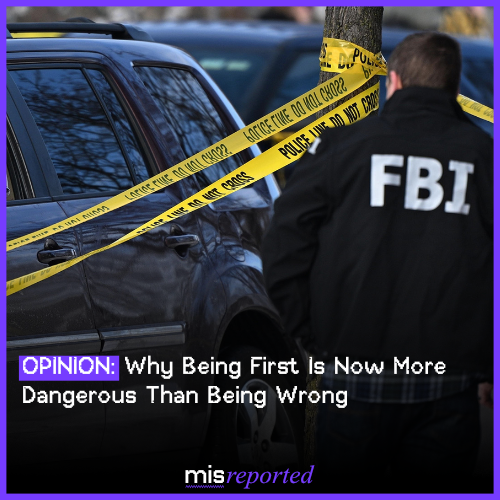
There is a familiar rhythm to crises now. Something violent happens. Names are unknown. Images are partial. And into that vacuum rushes a crowd determined to solve the case before the facts exist. What follows is not investigation but attribution, not accountability but misdirection.
The Minneapolis shooting last week offered a clean example. Within hours of a federal officer killing a woman, social media identified a culprit. It was the wrong one. In fact, it was two wrong ones. Both happened to share a common name. Neither had any connection to the event. Both were publicly accused, harassed and threatened before the actual shooter was identified.
This was not a fringe phenomenon. It travelled quickly, with the assistance of AI-generated imagery, speculation framed as certainty and the assumption that if something feels plausible, it is publishable. The cost was borne not by anonymous institutions but by private individuals whose only mistake was to exist with an inconveniently common name.
This is what misreporting looks like in its modern form. Not a single false headline from a major outlet, but a distributed system of inference, amplification and confirmation bias. By the time authoritative reporting arrives, the damage has already been done.
What is striking is how predictable the pattern has become. Grainy footage appears. An AI tool is asked to fill in the gaps. A guess is made. That guess circulates. Platforms reward engagement rather than restraint. Corrections, when they arrive, carry none of the velocity of the original claim.
This is not simply a social media problem. Newsrooms sit downstream of the same incentives. The pressure to match the pace of online speculation leads to framing that outruns verification. In recent months, shootings, terror attacks and politically sensitive crimes have repeatedly produced premature conclusions, incorrect identities and quietly appended corrections. Each one, on its own, looks manageable. Together, they reveal a system that confuses immediacy with responsibility.
Artificial intelligence has accelerated this failure mode. Tools that hallucinate faces, names and backstories collapse the distinction between evidence and conjecture. They do not merely make errors; they manufacture confidence. A synthetic image feels explanatory, even when it is entirely wrong. That sense of explanation is intoxicating in moments of fear or anger.
The deeper problem is cultural. The internet has normalised a form of vigilantism that dresses itself up as accountability. Users speak the language of justice while bypassing the mechanisms that make justice possible. Verification is dismissed as delay. Caution is treated as complicity. The result is not truth arriving faster, but error arriving first.
For those caught in the crossfire, the consequences are tangible. Threats. Reputational damage. Fear. None of it undone by a later clarification.
Misreporting today rarely consists of a single false statement. It is a cascade. A name suggested. A face generated. A rumour repeated. Each step small enough to feel deniable. Collectively, they form an accusation.
The lesson from Minneapolis is not that people should trust institutions uncritically. It is that the alternative is not radical transparency but radical noise. In moments of crisis, the choice is no longer between speed and perfection. It is between restraint and harm.
Being first, it turns out, is not neutral. It is a decision. And increasingly, it is a costly one.