

The New York Times corrects obituary after mischaracterising Joel Habener’s role at Howard Hughes Medical Institute
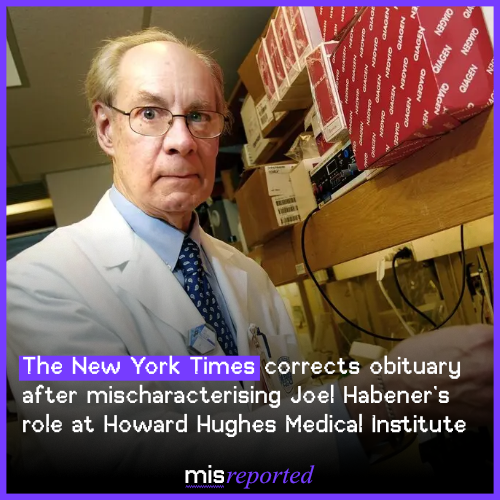
The New York Times has issued a correction to an obituary of Dr. Joel Habener, the endocrinologist whose research underpinned blockbuster weight-loss and diabetes drugs such as Ozempic and Wegovy, after misstating the nature of his relationship with the Howard Hughes Medical Institute.
The obituary originally stated that Dr. Habener had received a Hughes fellowship during his time at the institute between 1976 and 2006. A correction published several days later clarified that he was in fact a research investigator at the Howard Hughes Medical Institute, not a fellowship recipient.
The distinction is not merely semantic. Hughes investigators occupy a senior, highly selective role within the institute’s funding and research structure, distinct from fellows, whose status carries different implications for career stage, independence and institutional support. Misidentifying that relationship subtly but materially alters how a scientist’s standing and trajectory are understood, particularly in an obituary that seeks to situate a life’s work within the hierarchy of modern biomedical research.
The error appeared in an otherwise detailed account of Dr. Habener’s career, including his accidental discovery of GLP-1 in 1987 and its eventual transformation into a class of drugs reshaping the treatment of obesity and diabetes. The correction does not affect the substance of that scientific legacy, but it does underscore how even high-profile, carefully reported pieces can falter on institutional detail.
As with many such amendments, the correction was appended quietly, after the obituary had already circulated widely. In retrospective reporting, where reputations are fixed and public understanding crystallises quickly, such inaccuracies risk becoming part of the historical record if left unaddressed.
The Times corrected the record in line with its standards. The episode nonetheless illustrates how precision matters even in commemorative journalism, where distinctions of title, affiliation and status shape how contributions are remembered.