

The Guardian corrects Stella McCartney report after mischaracterising use of animal products
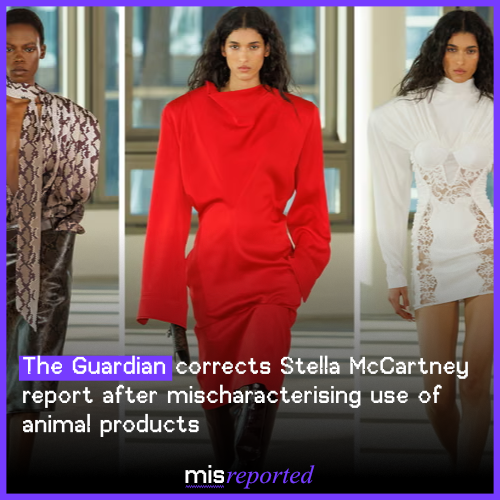
The Guardian has amended a report on the financial difficulties facing Stella McCartney’s fashion label after incorrectly stating that the brand does not use animal products.
The original article examined falling sales and widening losses at the luxury label, attributing part of its brand identity to an ethical stance that avoids animal-derived materials. A correction published several days later clarified that while the company does not use leather or fur, some of its clothing incorporates silk and wool.
The error did not affect the central financial reporting, which showed sales falling by more than a quarter and losses widening to £33.6 million in 2024. However, the misstatement materially overstated the absolutism of the brand’s ethical positioning at a moment when its long-term viability is under scrutiny.
Stella McCartney’s reputation has long been closely tied to claims of sustainability and animal welfare, making precision on such matters particularly important. Presenting the label as entirely free of animal products implied a stricter standard than the company itself applies, potentially shaping reader perceptions of both its values and its differentiation within a crowded luxury market.
The correction narrows that claim, aligning the article with the company’s actual practices. But as with many post-publication amendments, it arrived after the initial framing had already circulated widely. In business reporting, especially where brand identity underpins commercial strategy, such distinctions are not incidental.
The Guardian appended the clarification transparently. Still, the episode reflects a broader pattern in coverage of ethical consumer brands, where simplified narratives can edge into inaccuracy when complex sourcing practices are compressed into a single descriptor.