

The Guardian corrects Jerusalem protest report after misstating age of victim
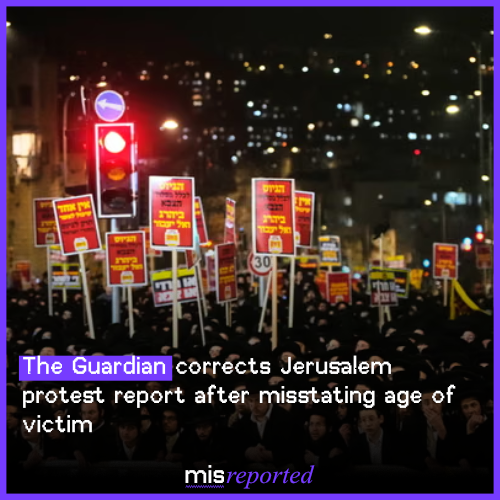
The Guardian has amended its reporting on the death of a teenager during an ultra-Orthodox protest against military conscription in Jerusalem after initially giving the wrong age for the victim.
The original article reported that an 18-year-old had been killed after being crushed by a bus during clashes between protesters and police. A correction published the following day clarified that the teenager was in fact 14, citing updated information from Israeli police.
While the correction did not alter the sequence of events described, the error materially affected how the incident was framed. Reporting the victim as an adult positioned the death within a narrative of violent disorder linked to mass protests over conscription laws. Revising the age to 14 reframes the incident as the death of a child, significantly changing its moral and political resonance.
The article itself described the protest as having turned violent, with police alleging that rioters blocked roads, damaged buses, threw objects and assaulted journalists. It also noted that the bus driver claimed to have been attacked before the fatal incident occurred. Those elements remained unchanged after the amendment.
However, the age correction arrived only after the initial version had circulated widely, at a moment when coverage of Israel’s internal tensions, particularly involving ultra-Orthodox communities and military service, is intensely scrutinised. In such contexts, early factual errors can shape interpretation before readers encounter subsequent clarifications.
The Guardian appended the correction transparently, noting that emergency services had initially given the wrong age. But the episode illustrates a recurring challenge in fast-moving conflict reporting: provisional details published under pressure can harden into narrative assumptions, even when later corrected.
As with other recent amendments across international coverage of Israel, the correction restored factual accuracy without revisiting the framing consequences of the original error. In stories involving death, protest and state force, those consequences are rarely neutral.