

Al Jazeera corrects Iran-US diplomacy report after mistakenly implicating Israel into talks breakdown
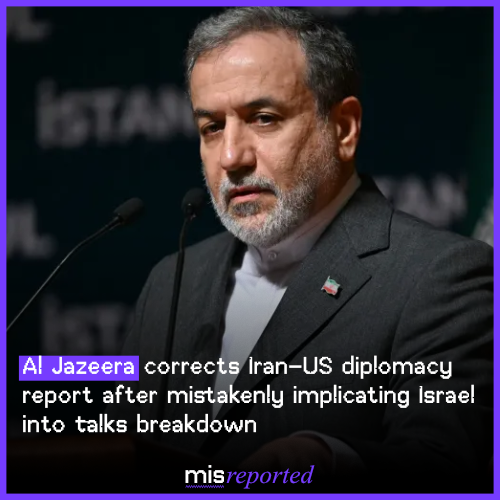
Al Jazeera has amended a report on rising tensions between Washington and Tehran after an earlier version incorrectly stated that direct communication between the United States and Israel had broken down, rather than between the United States and Iran.
The article, published on 14 January, focused on reports that diplomatic contact between senior Iranian and US officials had been suspended amid threats of US military action over Tehran’s crackdown on anti-government protests. Citing Reuters, it described a deterioration in already fragile US-Iran engagement and warned of broader regional escalation.
Yet an initial version of the story named the wrong parties. Instead of identifying a breakdown between Washington and Tehran, it asserted that US-Israel communication had collapsed. Al Jazeera later issued a correction clarifying that Israel was not involved in the reported suspension of talks.
The mistake is revealing. A rupture in US-Israel communication would represent an extraordinary and destabilising development, fundamentally altering assumptions about alliance coordination and regional security. That claim, even briefly published, carried far greater geopolitical weight than the reality it was later corrected to reflect. The fact that Israel was inserted into a story about US-Iran contacts at all points to a deeper reflex in coverage of the Middle East: Israel is so often treated as the central axis of every regional development that it appears even when it is not part of the event being reported.
Before the correction, readers could reasonably have inferred that tensions surrounding Iran’s internal repression and US threats had somehow spilled into Washington’s relationship with Jerusalem. That framing was not supported by the reporting and was unrelated to the substance of the Reuters source cited. Its presence reflected assumption rather than evidence.
The episode fits a broader pattern in international coverage where Israel is routinely foregrounded, even tangentially, in stories where it is not a principal actor. In this case, that reflex produced a factual error with outsized implications. The correction restores accuracy, but it also exposes how narrative habits can override basic verification, especially in outlets that frame much of the region through an Israel-centric lens.
Al Jazeera appended a correction on the day of publication acknowledging the error. As is often the case, the clarification arrived quietly, after the initial framing had already circulated. In fast-moving foreign affairs reporting, such slips matter not only because they are wrong, but because they reveal how certain assumptions are so ingrained that Israel enters the story almost by default.