

NPR corrects Trump economy speech report after misstating US action on Greenland
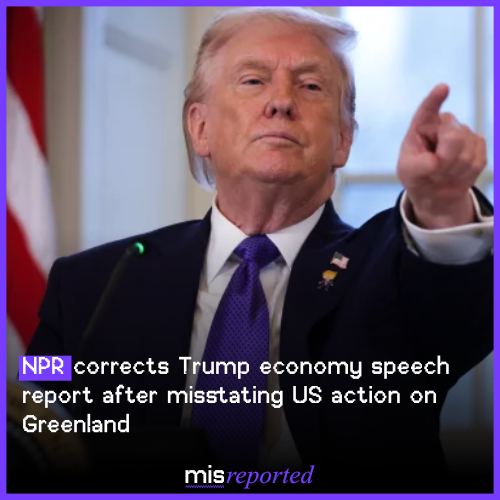
NPR has issued a correction to its coverage of President Donald Trump’s speech to the Detroit Economic Club after an earlier version incorrectly stated that the United States had seized Greenland, rather than threatened to do so.
The article, published on 13 January, examined a wide-ranging and combative address in which Mr Trump touted what he described as a resurgent US economy while repeatedly veering into attacks on political opponents, the Federal Reserve chair and domestic protest movements. In situating the speech within a broader news cycle dominated by foreign policy flashpoints, the report listed a series of international developments competing for the administration’s attention.
Among them was a claim that the United States had “captured” or seized Greenland. That assertion was wrong. As NPR later clarified, the Trump administration has threatened such action, but no seizure has taken place.
The distinction is not trivial. A threat to seize Greenland, however provocative, sits within the realm of rhetoric and diplomatic signalling. An actual seizure would represent an extraordinary breach of international law, a rupture with NATO allies and a geopolitical escalation of historic proportions. By collapsing the difference between threat and action, the original wording dramatically overstated the reality and altered the implied severity of US conduct abroad.
Before correction, readers could reasonably have concluded that Washington had already crossed a decisive threshold in its approach to Denmark and Arctic security. That impression materially reshaped the context in which Trump’s domestic economic remarks were framed, presenting them against the backdrop of an already consummated international crisis rather than a hypothetical or rhetorical one.
NPR appended a correction on 14 January acknowledging the error. The amendment restores the factual record, but the episode illustrates a familiar pressure point in political reporting: the temptation to compress anticipated or threatened actions into accomplished facts when narrating a crowded news agenda. In fast-moving coverage, especially where rhetoric is aggressive and outcomes appear predictable, verbs do heavy work.
This case also underscores how foreign policy shorthand can distort understanding when precision gives way to pace. Saying that an administration has “threatened” an action preserves uncertainty and contingency. Saying it has already happened forecloses debate and misleads audiences about the state of the world they are reading about.
NPR’s correction addresses the specific inaccuracy. But it also highlights how easily dramatic language can outrun verification, even in otherwise straightforward explanatory reporting. When covering leaders who regularly blur the line between provocation and policy, that distinction becomes all the more important.