

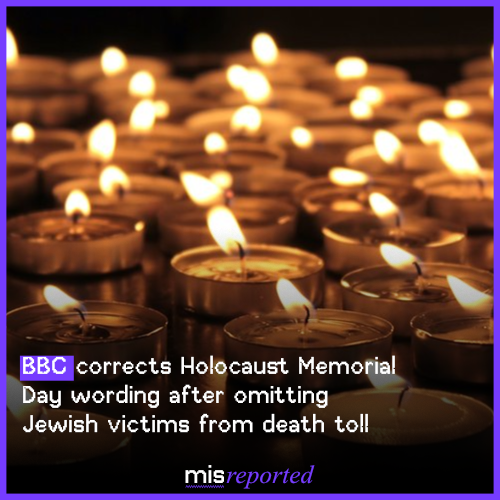
BBC corrects Holocaust Memorial Day wording after omitting Jews from death toll
The BBC corrected Holocaust Memorial Day coverage after referring to the victims as “six million people” or “six million mostly Jewish people” rather than six million Jews.
The miswording diluted the specificity of the Holocaust as the targeted genocide of the Jewish people, not a general wartime tragedy.
Although the BBC apologised, the correction followed widespread broadcasts on a day explicitly dedicated to historical precision and remembrance.
Al Jazeera corrects report after wrongly stating Palestinian man was killed by Israeli forces
This correction follows a familiar pattern in conflict reporting. In the rush to publish, early claims hardened into definitive statements, only to be walked back once fuller information emerged. As so often, the correction arrived after the narrative had already taken hold.
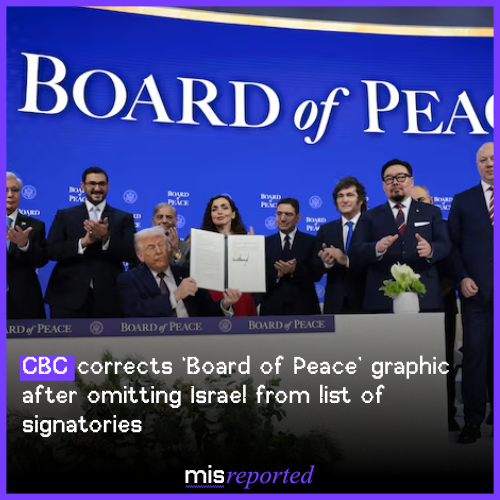
CBC corrects ‘Board of Peace’ graphic after omitting Israel from list of signatories
CBC initially published a graphic listing countries joining Trump’s “Board of Peace” that omitted Israel, despite Israel having accepted an invitation.
The broadcaster later corrected the omission, acknowledging that Israel should have been included among the signatories.
The error highlights how selective omissions, even when later corrected, can reflect and reinforce perceived editorial bias in coverage of Israel-related issues.
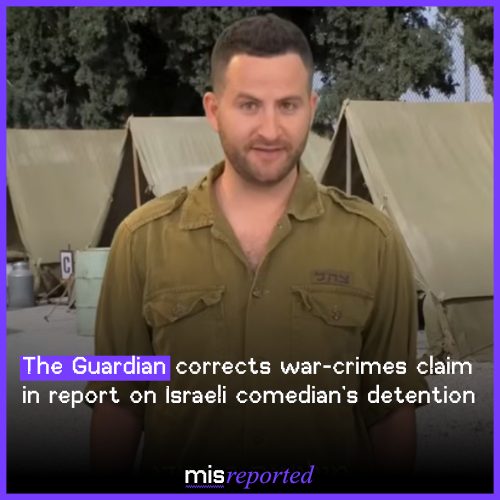
The Guardian corrects war-crimes claim in report on Israeli comedian’s detention
The Guardian amended a report on Guy Hochman’s detention after removing a false claim that he took part in the destruction of a mosque in Gaza.
The allegation originated from a legal group’s dossier and was later retracted by that same group, raising serious questions about verification standards.
As with many Israel-related corrections, the amendment was made quietly, long after the original accusation had already shaped reader understanding.
The New York Times corrects figures in reporting on historians’ push to condemn Israel
The New York Times corrected its reporting on the American Historical Association after overstating attendance at a vote and the organisation’s total membership.
Inflated figures risked exaggerating how representative the resolutions were, a key issue in a dispute about internal democracy and institutional authority.
The episode highlights how minor numerical errors can materially shape perception in politically sensitive coverage, particularly on Israel-related issues.
Al Jazeera corrects Iran-US diplomacy report after mistakenly implicating Israel into talks breakdown
Al Jazeera corrected a report after wrongly stating that US–Israel communication had broken down, when the reported suspension concerned US–Iran talks.
The error briefly suggested a major rupture in Washington’s relationship with Israel, a far more consequential claim than the reality later acknowledged.
The episode highlights how Israel is so routinely centred in Middle East coverage that it can be inserted even where it has no factual role, revealing bias through assumption rather than analysis.
The New York Times backtracks on factual error in Myanmar ICJ coverage
The New York Times corrected its ICJ reporting after misstating an allegation made against Myanmar.
The article wrongly referred to 54 houses being burned, rather than similar atrocities occurring across 54 villages.
The error illustrates how imprecise wording can distort the legal framing of genocide allegations.
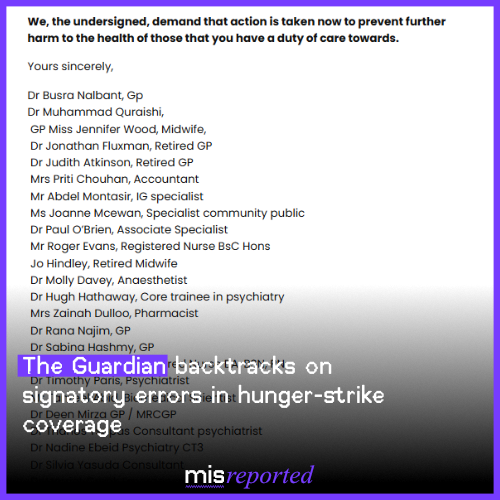
The Guardian backtracks on signatory errors in hunger-strike coverage
The Guardian has clarified that the November hunger-strike letter was signed by about 100 medical professionals, not more than 800.
Earlier, it had implied that over 800 medical professionals had signed the November letter.
That distinction matters, because misframing advocacy figures risks stirring needless alarm by exaggerating professional consensus and misleading readers about the scale and timing of medical concerns in a sensitive public debate.
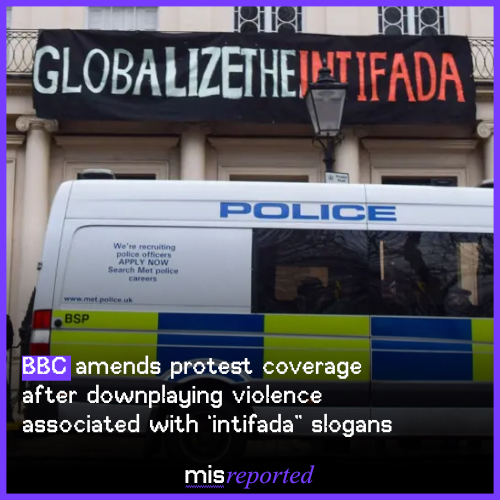
BBC amends protest coverage after downplaying violence associated with “intifada” slogans
The BBC altered its background explanation of “intifada” after criticism that it downplayed the violence historically associated with the term.
The original framing shaped how readers understood police action and Jewish concerns, while the amendment was issued quietly and without revisiting the broader narrative.
The episode reflects a wider pattern in which misreporting around Israel and antisemitism is corrected late and softly, leaving initial impressions largely intact.
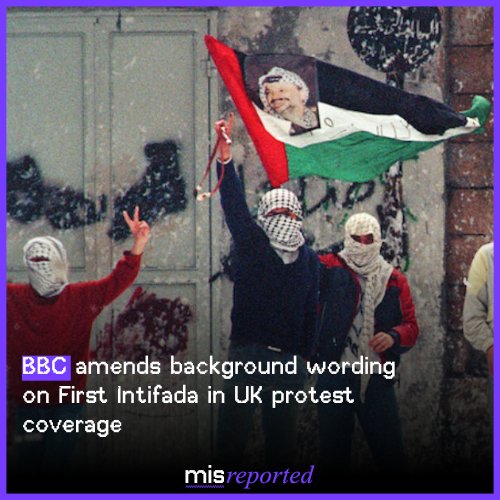
BBC amends background wording on First Intifada in UK protest coverage
BBC corrected its reporting on background references to the First Intifada, clarifying that its earlier language did not provide a sufficiently complete or clear historical picture.
The original framing suggested a largely unarmed and benign uprising, which materially altered how readers would interpret the sensitivity and contemporary implications of the term.
That distinction matters, and misframing it risks undermining public trust, inflating narratives, or distorting accountability.
The Telegraph amends report on magistrate’s social media post after Oct 7 mischaracterisation
The Telegraph corrected an article after clarifying that a Hamas video shared by a magistrate did not contain language describing Israel as a cancer to be eradicated.
The original framing blurred the distinction between Hamas’s broader rhetoric and the specific content of the video in question.
That distinction matters, particularly in reporting on extremism, where precision determines whether scrutiny is evidence-based or overstated.
NewsGuard Corrects False AIPAC-ChatGPT Claim as Media Outlets Fail to Verify Viral Screenshot
NewsGuard corrected claims that ChatGPT displayed an AIPAC advertisement after finding the widely shared screenshot was fabricated.
The original reporting echoed a familiar pattern in which Israel-related allegations are amplified without standard verification checks.
That distinction matters, and misframing it risks undermining public trust, inflating narratives, or distorting accountability.
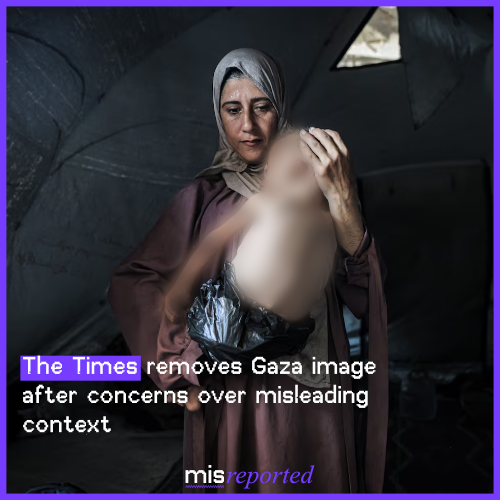
The Times removes Gaza image after concerns over misleading context
The Times removed a Gaza photograph and deleted related text after concerns were raised that the material lacked essential medical and operational context.
The original presentation encouraged readers to interpret the image as evidence of conflict-related starvation and violence without accommodating verified alternative explanations.
That distinction matters, and misframing it risks undermining public trust, inflating narratives, or distorting accountability.

The Guardian corrects detail in coverage of Palestine Action proscription hearing
The Guardian corrected its reporting on the High Court case involving Palestine Action by amending a spelling error in a named individual’s details.
The original coverage prioritised immediacy and narrative framing, contributing to a compressed account that left key legal and contextual distinctions underdeveloped.
That distinction matters, and misframing it risks undermining public trust, inflating narratives, or distorting accountability.

The New York Times corrects description of Israeli conditions for reopening Gaza border crossing
The New York Times corrected its reporting on the reopening of the Rafah crossing, clarifying that Israel said it would be opened in both directions once the remains of the final captives believed to be held in Gaza are returned.
The original framing implied that Israel was restricting the crossing independently of ceasefire conditions, materially altering how readers would interpret responsibility for the delay.
That distinction matters, and misframing it risks undermining public trust, inflating narratives, or distorting accountability.
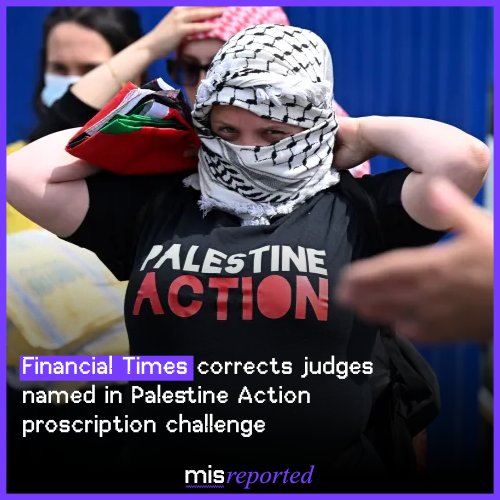
Financial Times corrects judges named in Palestine Action proscription challenge
The Financial Times corrected an error identifying the judges assigned to hear the High Court challenge to the government’s proscription of Palestine Action.
While procedural, the mistake mattered in a case where judicial composition shapes expectations about how counterterrorism powers and protest rights will be tested.
The correction underlines how even small inaccuracies in legally sensitive reporting can erode confidence in coverage of contested political issues.

The New York Times corrects name of reservist in Binance lawsuit report
The New York Times has clarified that the Israel Defense Forces reservist cited in its Binance terrorism-finance lawsuit coverage was named Omer Balva, not Omar Balva.
Previously, it reported his given name incorrectly in an article on families suing Binance over alleged facilitation of funds for Hamas and other terrorist groups.
That distinction matters, and misframing it risks eroding confidence in the accuracy of conflict reporting, diminishing respect for individual victims and reinforcing concerns that high-stakes stories on this war are being corrected too quietly and too late.
Opinion: The BBC Asked for Patience. Fresh Data Shows Why It Won’t Get It.
A new analysis of BBC headline patterns has exposed a structural imbalance that the corporation can no longer explain away as coincidence. Over the past two years, headlines relating to Israel were three times more likely to frame the state as culpable than to apply equivalent scrutiny to Hamas. On its own, the dataset is limited. In the context of the BBC’s wider editorial crisis, it is diagnostic.
Opinion: The BBC’s Elevenfold Error and the Fragility of Trust
The BBC’s correction this week - reducing its report of 44,000 blocked aid pallets in Gaza to the actual figure of 4,000 - is remarkable not simply for its scale but for what it reveals. An eleven-fold exaggeration is an editorial malfunction of a type that alters the entire informational architecture of a story. In conflicts where numbers frame diplomatic argument, such inflation carries consequences well beyond the paragraph in which it first appeared.
The BBC corrects major exaggeration in reporting on blocked Gaza aid supplies
The BBC has clarified that 4,000 pallets of aid are blocked from entering Gaza, not 44,000 — an eleven-fold exaggeration in the original report.
Previously, its article portrayed an almost total humanitarian obstruction, based on a figure now acknowledged to be vastly overstated.
That distinction matters, and such exaggeration risks fuelling perceptions of bias, undermining confidence in conflict reporting, and weakening public trust when accuracy is most essential.