

BBC amends protest coverage after downplaying violence associated with “intifada” slogans
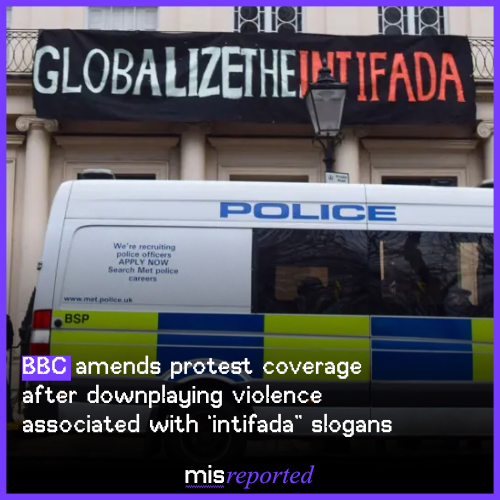
The BBC has amended its reporting on police arrests linked to chants of “globalise the intifada” at pro-Palestinian protests in London, quietly revising background language that critics said understated the violent history associated with the term. The change, issued as an update rather than a standalone correction, followed police warnings that the context around such slogans had shifted after a series of deadly antisemitic attacks.
The original article reported on the Metropolitan Police and Greater Manchester Police’s decision to arrest individuals chanting or displaying slogans invoking “intifada”, following the mass shooting at a Hanukkah gathering in Sydney and an earlier knife attack at a synagogue in Manchester. In an attempt to provide historical context, the BBC initially described the first Palestinian intifada as “largely unarmed”, language that framed the slogan as closer to political protest than to violence. That characterisation was later removed, with the broadcaster acknowledging that it did not provide “a clear enough or complete picture of the history”.
The revision matters because the meaning of “intifada” is not abstract or academic in current debates. While some activists insist the term refers to peaceful resistance, it is inseparable in Israeli and Jewish experience from waves of stabbings, shootings and bombings that targeted civilians. Israeli victims of the second intifada, in particular, were overwhelmingly non-combatants. To describe the concept in softened terms, especially in reporting about chants made amid a global rise in antisemitic violence, inevitably shapes how readers interpret both police action and Jewish concerns.
This episode sits within a broader pattern of misreporting that has repeatedly worked to Israel’s detriment. Across coverage of protests, conflict and antisemitism, initial framing often minimises or sanitises threats directed at Jewish communities, only for clarifications to arrive later and with little prominence. In this case, the BBC’s amendment did not revisit the broader thrust of the article, nor did it grapple with why police chiefs explicitly linked the slogan to recent acts of terror. Instead, it quietly adjusted the historical aside and moved on.
Such corrections rarely travel as far as the original framing. By the time an update is appended, the narrative has already settled: protesters are exercising contested speech, police are accused of overreach, and Jewish fears are treated as subjective or politically motivated. The correction restores factual balance on paper, but it does little to counter the initial impression that calls for “intifada” exist in a morally neutral space.
For Israel and for Jewish communities abroad, this asymmetry is familiar. Misreporting does not usually take the form of outright falsehoods, but of selective context and incomplete history. When amendments are issued quietly, without reflection on how the original language shaped understanding, the effect is cumulative. Each individual correction may seem minor. Together, they contribute to a media environment in which incitement is softened, threats are relativised, and the burden of proof is placed on those warning about antisemitism rather than those amplifying its language.