

The New York Times corrects description of Israeli conditions for reopening Gaza border crossing
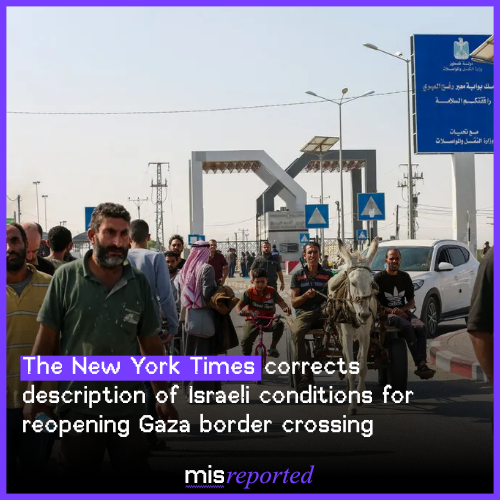
The New York Times has amended an article reporting on Israel’s plans to reopen the Rafah crossing between Gaza and Egypt, clarifying the conditions under which the crossing would operate in both directions. A correction appended to the piece stated that an earlier version misstated Israel’s position, and that Israeli officials had said the crossing would fully reopen only once the bodies of the remaining captives believed to be held in Gaza are returned.
The article initially reported that Israel intended to reopen Rafah only to allow Palestinians to leave Gaza, framing the move as a deviation from the terms of the October ceasefire agreement with Hamas. Egypt was quoted as denying coordination with Israel, and the report suggested that Israel had unilaterally narrowed the scope of the reopening. The correction adjusted this account, noting that Israel’s position involved conditionality tied to the completion of commitments made by Hamas under the same ceasefire framework.
Before correction, the reporting implied that Israel was withholding the reopening of Rafah without reference to reciprocal obligations embedded in the agreement. The absence of that context positioned Israel as the sole party delaying implementation, while Hamas’s responsibilities under the deal were mentioned only later and without direct linkage to border operations. Readers could reasonably infer that the restriction reflected policy preference rather than unresolved compliance issues.
That framing materially altered the balance of the story. The Rafah crossing is not merely a humanitarian passage but a strategic and security-sensitive gateway governed by negotiated terms, third-party monitoring and sequencing conditions. Presenting Israel’s position without foregrounding the conditional return of captives obscured the extent to which border arrangements were tied to verification and enforcement mechanisms agreed by both sides.
The correction narrowed this gap by making clear that Israel’s conditions were not an after-the-fact imposition but part of an articulated sequencing requirement linked to hostage recovery. This distinction matters in understanding both the legal structure of the ceasefire and the ongoing diplomatic impasse. Without it, the narrative tilts toward arbitrariness rather than conditional compliance.
The episode reflects a broader pattern in reporting on Israel-related agreements, where implementation disputes are often described asymmetrically. Commitments undertaken by armed non-state groups tend to be presented as contested claims, while delays by states are framed as affirmative choices. Over time, this approach risks compressing complex enforcement debates into simplified accounts of obstruction.
Precision in describing ceasefire terms and conditions is central to informed reporting on border access, humanitarian corridors and post-conflict administration. Corrections of this kind restore alignment between factual detail and interpretive framing, ensuring that readers can assess responsibility with reference to the full scope of agreed obligations rather than isolated actions.