

Opinion: Why Asia’s latest catastrophes exposed a media problem
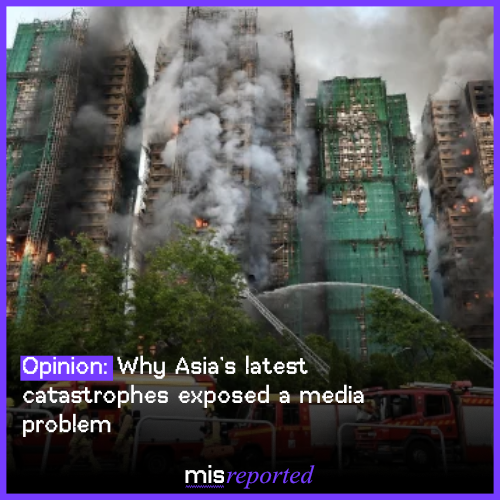
In the immediate aftermath of a disaster, information becomes almost as critical as food, water or medical care. Yet it is precisely at these moments that reporting is most vulnerable to haste, distortion and premature certainty. Misreporting during catastrophic events does not merely mislead audiences; it risks undermining emergency response, public health decision-making and the fragile sense of control that authorities and communities are struggling to maintain.
Recent coverage of major disasters in Asia illustrates the problem. As fires, floods and mass-casualty events unfold, media outlets increasingly rely on a fast-moving mix of satellite imagery, social media footage, eyewitness accounts and partial official statements. This material is valuable, but taken together without rigorous verification, it can also create a fog of conflicting claims. Death tolls fluctuate wildly, timelines shift by the hour and dramatic imagery circulates long before its provenance or context is established.
The danger lies not in the act of reporting quickly, but in presenting provisional information as settled fact. Casualty estimates that later prove inaccurate can distort how resources are allocated. Overstated damage can trigger unnecessary panic; understated impact can delay assistance. Emergency responders and humanitarian organisations monitor media closely, particularly in the early stages when formal reporting channels are overwhelmed. When journalism becomes another source of noise, coordination suffers.
There is also a psychological cost. Disasters already strip individuals and institutions of control. Roads are impassable, communications fail, and familiar routines collapse. When media reports add confusion rather than clarity, they reinforce a perception that events are spiralling beyond comprehension. That perception can be as destabilising as the physical damage itself. Trust in authorities weakens, rumours spread and compliance with public safety guidance erodes.
Verification is not an abstract journalistic virtue in these moments; it is an operational necessity. Satellite imagery must be time-stamped and geolocated. Video clips need authentication. Witness accounts require corroboration. Without these checks, narratives form around the most vivid images rather than the most accurate ones. In an attention economy, the most dramatic frame often outpaces the most reliable assessment.
The problem is compounded by the global nature of modern news consumption. Footage shot on a phone in one city can be mislabelled, repurposed or detached from its original context within minutes. As this material is aggregated by respectable outlets, the line between verified reporting and digital hearsay blurs. Corrections may follow, but by then the initial framing has already shaped public understanding.
This matters especially for public health. In floods, fires or structural collapses, misinformation about contamination risks, missing persons or access routes can have direct consequences for survival. Health agencies depend on a baseline of accurate public information to triage, evacuate and treat. When that baseline is unstable, response efforts slow and risks multiply.
None of this is an argument for silence or delay. It is a case for disciplined restraint. The pressure to be first is intense, but in disasters, being right matters more than being early. Journalism that foregrounds what is known, distinguishes clearly between confirmed facts and ongoing investigation, and resists the allure of spectacle does more than serve readers. It becomes part of the response infrastructure.
Misreporting during disasters does lasting damage beyond any single event. It teaches audiences that information itself is unreliable at moments of crisis, deepening a broader sense of vulnerability and helplessness. When people cannot tell which reports to trust, the feeling that no one is in control takes hold quickly. That is corrosive, not just to emergency management but to institutional credibility in its widest sense.
In crises defined by uncertainty, the media’s role is not to eliminate confusion entirely, an impossible task, but to avoid amplifying it. Accuracy, context and humility about what is not yet known are not luxuries reserved for calmer times. In disasters, they are forms of public service as essential as the emergency crews working through the debris.