

Why everything felt more chaotic in 2025 than it actually was
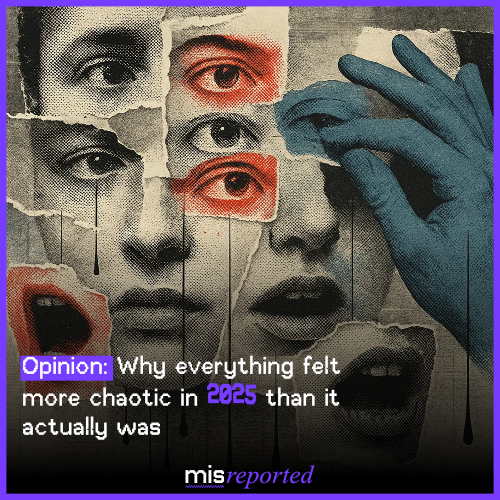
Few years have felt as relentlessly unstable as 2025. Wars appeared to expand without warning, disasters seemed more frequent and more deadly, migration debates hardened overnight, and institutions struggled visibly under pressure. Yet in many cases, the underlying realities were less volatile than the coverage suggested. What made the year feel chaotic was not only what happened, but how it was reported.
Across politics, conflict, public safety and technology, a recurring pattern emerged: provisional information was presented as settled fact; context arrived late, if at all; and corrections followed quietly, long after narratives had lodged in the public mind. The result was a constant sense of escalation, even when events were static, contained or conditional.
Nowhere was this clearer than in foreign conflict reporting. Ceasefires were described as broken without explaining the obligations they imposed or the enforcement failures that preceded military action. Armed groups were referred to in euphemistic terms, their legal status clarified only deep in articles, if at all. Casualty figures were aggregated without distinction, while operational roles were omitted, flattening events into moral tableaux. Nothing in this was necessarily false. Much of it was incomplete. And incompleteness, repeated at scale, proved destabilising.
The same dynamic played out in coverage of disasters. Early casualty estimates ricocheted across platforms, only to be revised downward days later. Footage circulated before verification, timelines blurred, and dramatic imagery filled gaps where certainty was unavailable. For emergency responders and public health agencies, such reporting did more than confuse the public; it complicated coordination and eroded compliance. For audiences, it reinforced the impression that events were spiralling beyond anyone’s control.
Even domestic debates were not immune. Crime statistics were misstated, legal thresholds elided, regulatory actions mischaracterised. Opinion pieces rested on figures later corrected, or on assumptions that data did not support. The errors were often small but cumulative. Each one shaved a little from institutional credibility, until scepticism itself became the default stance.
Part of the explanation lies in incentives. Speed is rewarded; context is not. Corrections repair the record but rarely the impression. In a competitive information environment, it is safer to amplify urgency than to dwell on uncertainty. Yet 2025 demonstrated the cost of that trade-off. A public exposed to a continuous stream of misframed events begins to experience instability as ambient, permanent and ungovernable, even when systems are functioning, however imperfectly, in the background.
This is not an argument that 2025 was benign. Genuine crises occurred, lives were lost, and institutions were tested. But chaos is not merely a measure of events; it is a measure of perception. And perception is shaped by narratives that privilege immediacy over proportion and assertion over explanation.
The year’s defining failure was not dishonesty but haste. Journalism did not abandon accuracy so much as it abandoned patience. That distinction matters. In a world already primed for anxiety, incomplete stories do not just misinform; they magnify uncertainty.
As 2025 closes, the task for serious media is not retrospection but restraint. Without slower framing and firmer context, even relatively stable years will feel unmoored. Chaos, after all, is not only what happens when systems collapse. It is also what happens when the public is never quite sure what is actually going on.