

The Guardian corrects detail in coverage of Palestine Action proscription hearing
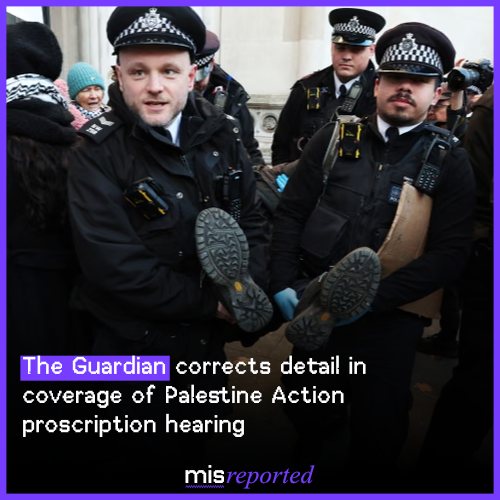
The Guardian has amended its reporting on a High Court challenge to the proscription of Palestine Action to correct the spelling of the name of a relative of one of the defendants. A note appended to the article on 3 December stated that an earlier version misspelled Shahmina Amal’s first name. While the correction addressed a minor factual error, it nonetheless sits within a broader pattern of compressed and hurried reporting on issues connected to Israel and Palestine.
The original article covered legal arguments advanced against the Home Secretary’s decision to proscribe Palestine Action, presenting the case as a contest between civil liberties and state overreach. It quoted extensively from counsel for the claimant, characterising the group as part of an “honourable tradition” of direct action and civil disobedience, while presenting the government’s position largely as a rebuttal to that framing. The factual correction itself related only to a name, but the overall structure of the piece reflected a narrower editorial emphasis.
Before amendment, the report had already illustrated how speed and immediacy often dominate coverage of Israel- and Palestine-linked stories. The urgency to publish updates, court developments and human-interest details frequently results in articles that foreground accusation, rhetoric and protest imagery ahead of careful differentiation between legal findings, disputed claims and established facts. Even when errors are minor, their presence signals a production environment where verification competes with velocity.
In this case, the wider misframing lay not in typographical inaccuracy but in omission and prioritisation. The article devoted significant space to characterisations of Palestine Action’s aims and public support, while giving less weight to the legal threshold for proscription, the statutory definition of terrorism relied upon by the government, or the distinction between protest activity and repeated, escalating damage to defence infrastructure. Context that might complicate the narrative was present, but subordinated.
Such patterns are familiar in reporting on the Israel-Palestine issue more broadly. Legal proceedings, military actions and protest movements are often covered through a lens that privileges moral urgency over procedural clarity. Editorial caution, where it appears, tends to be asymmetric: claims critical of Israel are frequently relayed with minimal interrogation, while Israeli actions are framed as assertions that require sceptical attribution. The result is not overt bias but cumulative confusion.
Corrections like this one restore surface accuracy, but they do little to address the deeper issue of rushed framing. When highly charged topics are reported at speed, small errors coexist with larger ambiguities, leaving readers with a fragmented understanding of events. Over time, this erodes confidence not only in individual articles but in media coverage of the conflict as a whole.
Precision matters most in areas where emotions run high and legal distinctions are central. Reporting that blurs activism with legality or treats contested characterisations as settled truth risks deepening misunderstanding between audiences already divided by distance and ideology. The amendment corrects a name, but the episode underscores how quickly clarity can be lost when complex, polarised subjects are filtered through accelerated news cycles.