

The Times clarifies account of MI5 scrutiny in Salisbury inquiry coverage
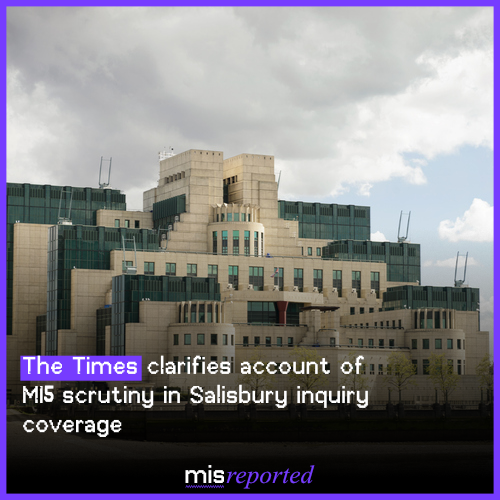
The Times has issued a clarification to its reporting on the public inquiry into the Salisbury novichok poisoning, correcting its description of the inquiry’s findings regarding MI5. An earlier news report stated that the security service was expected to face censure for leaving Sergei Skripal “alarmingly accessible” to Russian assassins. In fact, the inquiry concluded that the attack could not have been prevented through additional security measures and did not criticise the UK security services.
The original article, published on 4 December, focused primarily on the inquiry’s conclusion that the poisoning of Sergei Skripal had been authorised at the highest levels of the Russian state. Against that backdrop, it suggested that MI5 might be faulted for failing to impose stricter protective arrangements on Skripal after his resettlement in the UK. That formulation implied an institutional lapse running parallel to the foreign intelligence operation that ultimately led to the attack.
The inquiry’s published findings, however, reached a different conclusion. While identifying deficiencies in administrative processes, such as the absence of regular written security assessments, the chair found that these shortcomings had no causal link to the poisoning. The report explicitly stated that even enhanced security measures would not, on the balance of probabilities, have prevented the attack, short of imposing life-altering restrictions that were not judged proportionate at the time. As such, the inquiry did not censure MI5 or other security bodies.
The misstatement materially altered how responsibility and preventability were framed. Suggesting that MI5 faced censure implied that the attack lay, at least in part, within the control of UK authorities. The inquiry’s actual conclusion shifts understanding in the opposite direction: that the operation was designed to be exceptionally difficult to disrupt and that responsibility rests overwhelmingly with the perpetrators and their sponsors, rather than with domestic security failings.
This distinction matters in a case that has shaped debates about state responsibility, deterrence and the limits of protective intelligence. The Salisbury attack has often been cited as evidence of gaps in the UK’s security posture. The inquiry’s findings complicate that narrative, emphasising the constraints under which intelligence services operate when assessing risk, proportionality and civil liberties. Collapsing that complexity into an expectation of censure simplifies a more restrained institutional judgement.
The correction also illustrates how forward-looking interpretations can harden into apparent conclusions in pre-publication reporting. Anticipating findings is a staple of political journalism, but when those expectations are not borne out by official conclusions, the resulting misalignment can skew public understanding, particularly in cases involving national security and intelligence oversight.
Precision in reporting inquiries of this kind is central to credibility. Such processes exist not only to assign responsibility but to delineate what could reasonably have been foreseen or prevented. By clarifying that the inquiry did not criticise MI5, The Times has narrowed the gap between speculation and the formal record, restoring accuracy to a question with significant institutional implications.