

The New York Times corrects capital error in reporting on political unrest in Benin
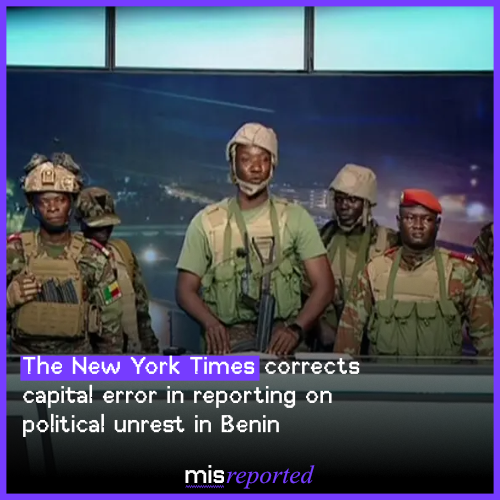
The New York Times has amended its reporting on an attempted coup in Benin after misstating the country’s capital, confusing Porto-Novo with its largest city, Cotonou. A correction appended to the article acknowledged the error. While seemingly minor, the mistake is instructive, illustrating how speed and assumption continue to shape Western reporting on parts of the world deemed peripheral, even in moments of acute political uncertainty.
The article described a day of confusion after members of the Beninese military attempted to seize power, detailing arrests, gunfire reports and statements from domestic and regional authorities. It referenced soldiers patrolling outside national media offices and cited diplomatic alerts from foreign embassies. In doing so, it repeatedly treated Cotonou as the capital of Benin, an error that remained online until after publication.
Before correction, the reporting conveyed a familiar but imprecise picture: instability in “another” West African state, with geography flattened to the most recognisable urban centre. That framing matters because capitals are not trivia. They determine where constitutional authority resides, where institutions formally operate, and how power is organised. Confusing the political capital with the commercial hub subtly distorts how events are understood, particularly for readers with limited prior exposure to the country.
The error also speaks to a broader pattern in high-speed international reporting. In breaking news scenarios, especially outside Europe or North America, certain details are assumed rather than checked. Large cities stand in for states, regional trends stand in for national politics, and long-established facts are treated as interchangeable. The result is coverage that is not overtly inaccurate in its central claims, but lightly careless around the scaffolding that makes those claims intelligible.
That carelessness contributes to a sense of confusion that compounds the events themselves. Coups, mutinies and political instability already test public understanding. When basic factual anchors are wrong, audiences are left unsure what else may be provisional. In contexts where trust in information matters for diplomacy, markets and security assessments, such slippage carries consequences beyond embarrassment.
There is also an uncomfortable asymmetry at work. Errors of this kind are far less likely to occur when reporting on Paris, Warsaw or Canberra. Knowing the capital is treated as a minimum requirement. Its absence in coverage of African states reflects an older hierarchy of attention, where accuracy is assumed to matter less because readership is presumed to care less. That assumption no longer holds, yet its residue remains visible.
The Times corrected the record promptly once the mistake was identified. But the correction does not undo the initial signal sent to readers: that urgency trumped elementary verification. In a year already marked by misreporting that amplified instability and anxiety, such moments reinforce the impression that global events are not just volatile, but poorly understood.
Precision is not pedantry, especially during crises. Knowing where power formally sits is part of knowing how a country works. When that slips, confusion follows. And confusion, repeated often enough, becomes part of the story itself.