

The New York Times backtracks on factual error in Myanmar ICJ coverage
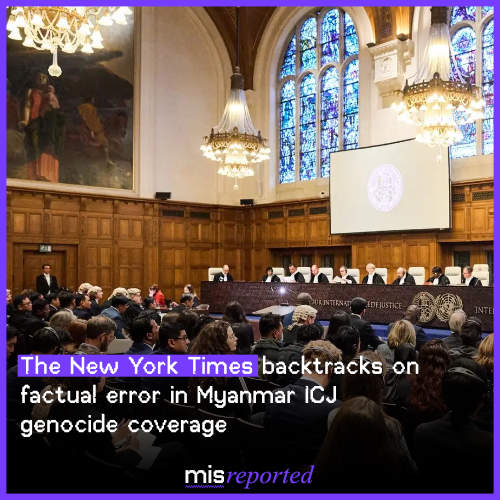
The New York Times has corrected its reporting on proceedings at the International Court of Justice after misstating a central factual allegation made by a lawyer representing The Gambia in the Rohingya genocide case against Myanmar. The amendment clarifies that the court was told atrocities were committed across 54 villages, not that 54 individual houses were burned with people inside them.
The original version of the article attributed a far narrower and more specific claim to Paul Reichler, the lawyer addressing the court, stating that “54 houses had been burned with people in them.” That formulation has now been corrected to reflect what was actually alleged: that very similar atrocities — including the burning of houses with people inside — occurred across 54 villages during Myanmar’s military operations.
While the correction does not reduce the gravity of the allegations before the court, it materially alters the scale and structure of the claim being made. Confusing the number of houses with the number of villages compresses a pattern-based allegation into a single numerical event, changing how readers may understand both the evidentiary basis of the case and the nature of the argument being presented to judges.
Precision is particularly critical in reporting on international legal proceedings, where allegations are framed carefully to establish patterns, intent, and scope. Small numerical or contextual errors can misrepresent how legal arguments are constructed, especially in genocide cases where the distinction between isolated incidents and systematic conduct is legally significant.
The correction highlights the importance of careful transcription and interpretation of courtroom statements in high-stakes international cases. Even where the underlying allegations remain serious, inaccurate phrasing risks misleading audiences about what was actually argued before the court and how international law assesses claims of mass atrocity.