

The Telegraph amends report on magistrate’s social media post after Oct 7 mischaracterisation
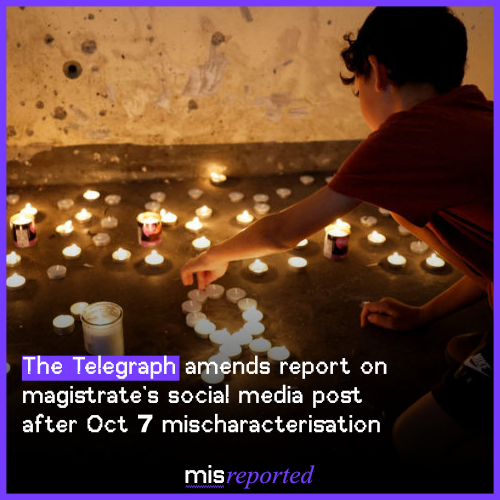
The Telegraph has amended an article concerning a magistrate who shared a Hamas video following the October 7 attacks, clarifying that the video itself did not describe Israel as “a cancer that should be eradicated,” contrary to what readers could reasonably have inferred from the original wording.
The article, first published in February, examined the conduct of Mr Malik, a magistrate who had shared footage related to the Hamas attacks. In its original form, the report stated that the video characterised Israel as a cancer that should be eradicated. A subsequent amendment now makes clear that while Hamas officials have previously used such language, it did not appear in the specific video shared by Mr Malik.
The distinction is material. Attributing explicit genocidal language to a particular piece of content elevates the severity of what was shared and sharpens the implications for the individual involved. By conflating the broader rhetoric of Hamas with the contents of a single video, the original framing blurred the line between documented organisational ideology and the specific material under scrutiny.
The correction narrows that gap. It preserves the underlying fact that the magistrate shared a Hamas-linked video, while removing an allegation that went beyond the evidence contained in that material. In doing so, it alters how readers assess both intent and gravity, particularly in a legal and professional context where precision matters.
This episode reflects a recurring challenge in coverage of extremist groups. Organisations such as Hamas have well-documented ideological positions, including explicit calls for Israel’s destruction. But reporting that imputes those positions wholesale to every associated document, video or individual interaction risks overstating what can be substantiated in a given case.
The Telegraph’s amendment brings the article back into closer alignment with the specific facts. As with other recent corrections across the media landscape, it illustrates how errors often arise not from fabrication but from compression: collapsing background knowledge into claims about particular evidence without sufficient separation.
In sensitive reporting involving terrorism, antisemitism and public officeholders, that separation is essential. The difference between what an organisation has said historically and what appears in a specific artefact is not semantic. It shapes accountability, interpretation and public trust.