

RT India deletes post claiming Pakistan’s prime minister was left waiting for Putin
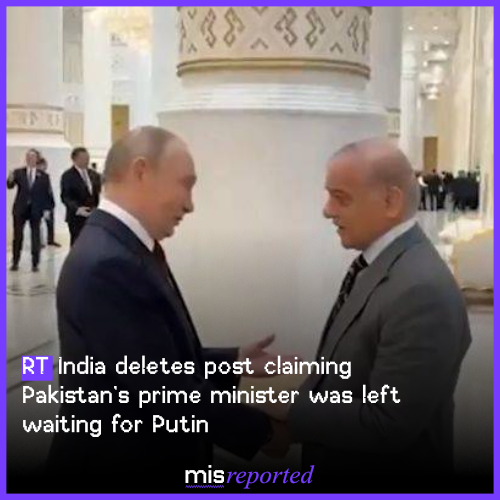
RT India has deleted a post on X that claimed Pakistan’s prime minister, Shehbaz Sharif, was kept waiting for Russian president Vladimir Putin before interrupting a meeting, acknowledging that the account “may have been a misrepresentation of events”.
The now-removed post concerned Mr Sharif’s attendance at an international forum in Ashgabat, Turkmenistan, where he held a series of bilateral meetings on the sidelines, including with Mr Putin, Turkish president Recep Tayyip Erdogan and Iranian president Masoud Pezeshkian. Official footage released by the Pakistani government, the prime minister’s office and the Russian embassy showed Mr Sharif greeting Mr Putin in what appeared to be a brief but cordial exchange.
According to Indian media reports, RT India’s deleted post alleged that Mr Sharif had waited for 40 minutes to meet Mr Putin, eventually “gate-crashing” the Russian leader’s discussion with Mr Erdogan before leaving shortly afterwards. That account was not supported by other official or media reporting. Russia’s RIA news agency later stated that Mr Sharif joined the Erdogan-Putin talks, which ran for approximately 40 minutes behind closed doors.
In a clarification issued late on Friday, RT India said it had removed the post because it “may have been a misrepresentation of the events”. No further explanation was provided as to how the original claim had been sourced or verified. The network is the newest branch of Russia’s state-funded RT operation and was launched only last week during Mr Putin’s visit to New Delhi.
The episode highlights how minor diplomatic moments can be quickly reframed into narratives of snub or humiliation, particularly when amplified through social media. In this case, imagery and official accounts consistently described routine bilateral engagement, while the deleted post introduced an adversarial interpretation that was later withdrawn.
RT India’s deletion corrects the immediate record, but the incident underscores a recurring pattern in fast-moving geopolitical coverage: suggestive framing outpaces verification, and corrections arrive only after an impression has already circulated. In diplomatic reporting, where symbolism often carries as much weight as substance, such mischaracterisations can distort public understanding of events that are, in reality, procedural and unremarkable.