

Why the world feels permanently on edge, even when it isn’t
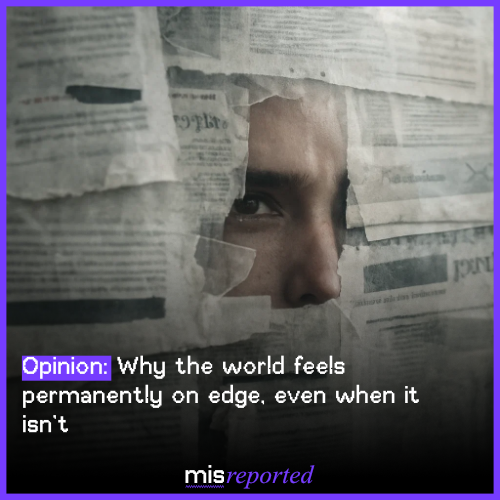
If there is a single lesson from the past year of corrections, deletions and quiet walk-backs, it is that public anxiety is no longer driven only by events themselves, but by how they are first framed. In 2025, much of daily life felt brittle. Institutions seemed unstable, crises unending, trust thin. Yet, when the record was revisited, the underlying facts were often narrower, slower and more bounded than the coverage suggested.
This was not a year of wholesale fabrication. It was a year of haste.
Again and again, major outlets corrected stories that were directionally sound but structurally weak. A coup in West Africa was reported accurately in spirit but stumbled over something as basic as the capital city. A senior British politician was briefly promoted to the wrong shadow cabinet role. A global health funding story implied settled donor withdrawal where uncertainty still prevailed. A campus shooting was initially described with incorrect locations and timelines. None of these errors overturned the core story. Each, however, nudged readers toward a sharper, more chaotic interpretation of events.
Nowhere was this dynamic more visible than in coverage shaped by images and implication. Photographs from Gaza circulated globally as proof of famine before crucial medical context emerged. A fabricated screenshot purporting to show political advertising inside an AI chatbot was amplified before elementary checks were applied. Parody content was folded into reporting as evidence of institutional sexism. In each case, the correction came later, quieter, and without the force of the original claim.
The effect is cumulative. Readers do not experience corrections as reassurance. They experience them as instability. When articles are amended without explanation, when claims are softened after having already circulated, the conclusion is not that journalism is self-correcting, but that reality itself is slippery. That sensation bleeds into everyday life. If the facts keep changing, then risk feels omnipresent and control illusory.
This matters because misreporting no longer sits at the margins of public debate. It intersects with decisions people make daily: whether to trust vaccines, whether institutions are acting in good faith, whether political violence is escalating uncontrollably, whether technology is being weaponised behind closed doors. When initial reporting overstates certainty, audiences absorb the alarm before they ever encounter the nuance.
The incentives are well known. Speed is rewarded, caution is penalised, and narrative coherence is prized over provisional accuracy. Introductions are written to grip before the evidence is fully assembled. Headlines compress complexity into something emotionally legible. By the time verification catches up, the moment has passed.
In retrospect, 2025 was not uniquely chaotic. What changed was the information environment. The distance between “breaking” and “accurate” widened, and the public lived in that gap. The result was a year that felt harsher, riskier and more ungovernable than the facts alone justified.
Misreporting, then, does not just distort understanding. It alters mood. It seeps into how societies perceive safety, competence and trust. When urgency masquerades as certainty, anxiety becomes the default setting.
The challenge ahead is not to slow journalism to a crawl, but to restore discipline at the point of first telling. Because in an age of instant narrative, the first version is the one that shapes lives, even if it turns out not to be the right one.