

The Guardian amends Bondi editorial after factual error in terrorism coverage
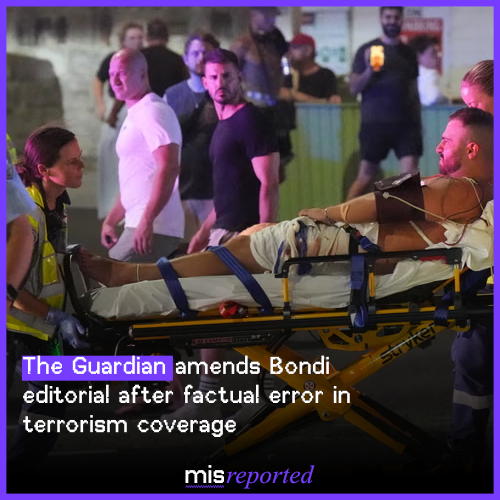
The Guardian has amended an editorial on the Bondi Beach terror shootings after incorrectly stating the year of the Christchurch mosque attack, issuing a correction that acknowledged the massacre took place in 2019, not 2022.
The correction was appended to an editorial describing the Bondi attack as an antisemitic act of terrorism targeting a Hanukah gathering on Sydney’s shoreline. The original piece sought to situate the shootings within a global rise in antisemitic violence and political extremism, referencing previous attacks in Australia, the UK, the US and New Zealand. In doing so, it misstated the date of the Christchurch attack in which 51 Muslim worshippers were killed by a white supremacist.
While the factual error was narrow, the episode drew attention to a broader issue in how antisemitic violence is framed in editorial coverage. The Guardian’s piece emphasised the need to prevent division and to treat the attack as an assault on society as a whole, repeatedly broadening the focus from Jewish victims to national and global cohesion.
That framing, coupled with the subsequent correction, highlights how coverage of antisemitic attacks is often shaped by a desire to universalise rather than foreground the specific nature of the hatred involved. The editorial explicitly identified the Bondi shootings as antisemitic, yet much of its analysis pivoted quickly toward abstraction, symbolism and collective moral response.
The correction itself addressed only the historical inaccuracy. It did not revisit the wider framing choices made in the editorial, nor did it clarify how those choices might affect reader understanding of antisemitism as a distinct and persistent form of political violence.
Such dynamics are not unique to this case. In recent months, multiple outlets have corrected factual errors in reporting or commentary related to Israel, Jewish communities or antisemitic incidents, often after narratives had already circulated widely. In many instances, corrections resolve discrete inaccuracies while leaving intact broader interpretive structures that critics argue can minimise or diffuse responsibility for antisemitic harm.
The Guardian’s amendment brings the record into factual alignment. But it also underscores how errors, even when corrected promptly, can sit within a wider pattern in which antisemitic violence is acknowledged yet reframed in ways that soften its specificity.
In highly charged reporting environments, particularly those involving terrorism and communal targeting, accuracy extends beyond dates and figures. It also encompasses how violence is contextualised, whose experiences are centred, and how responsibility is apportioned. Corrections address the first category. The latter often remains unexamined.