

NPR corrects details on timing and location in Brown University shooting coverage
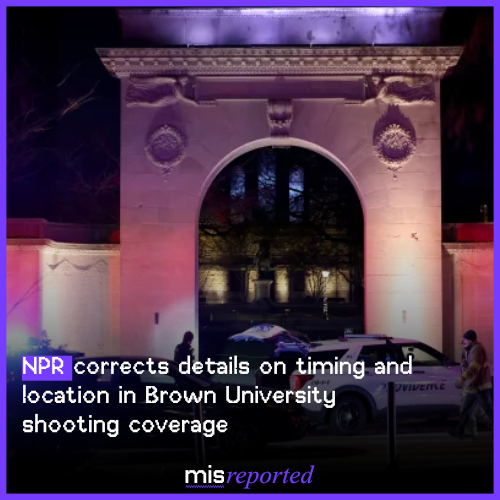
NPR has issued a correction to its reporting on a shooting at Brown University in Providence, Rhode Island, clarifying that several key details in an earlier version of its article were wrong. The outlet amended the piece to state that President Donald Trump’s remarks and Brown University’s emergency alert updates took place on Saturday night, not Friday night, and that the shooting occurred inside the Barus and Holley building, not outside it.
Before the correction, the original reporting implied a different sequence of events. By placing official statements and campus alerts a day earlier, the article created the impression of a longer, more extended information cycle than actually occurred. That matters in fast-moving incidents where public understanding depends heavily on chronology: when readers believe authorities were communicating earlier than they were, it can subtly shift perceptions of institutional responsiveness, situational control and the pace of the investigation.
The location error carried a different kind of consequence. Reporting that the shooting happened outside the Barus and Holley building suggests exposure to open space, different security assumptions and a potentially broader perimeter of risk. The corrected wording establishes that the attack took place inside a specific academic building during final exams. That change is not incidental. It recalibrates how readers understand access, campus safety measures and the immediacy of threat to people in enclosed areas, including why shelter-in-place guidance may have been issued and lifted when it was.
These are the kinds of inaccuracies that often enter coverage through compression. Early reports, hurried rewrites and reliance on incremental official updates can produce errors that are not malicious but are still consequential. In breaking-news reporting, time markers and physical locations function as the scaffolding that holds the narrative up. When that scaffolding is wrong, even temporarily, readers are left with a distorted picture of what happened, when it happened and what institutions knew at the time.
The correction also sits alongside the article’s own description of confusion earlier in the day about whether a suspect was in custody. In other words, the story being reported was partly about uncertainty, yet the reporting itself introduced avoidable uncertainty through incorrect timing and an inaccurate description of where the attack took place. The result is a familiar dynamic in crisis coverage: the public experiences not just the volatility of the event, but the volatility of its narration.
NPR’s correction restores the factual record. But the episode underscores why precision matters most in precisely these circumstances. In mass-casualty reporting, the difference between Friday and Saturday, and between outside and inside, is not pedantry. It is the difference between an intelligible public account and a misleading one, and it shapes how trust is allocated in the hours when trust is under the greatest strain.