

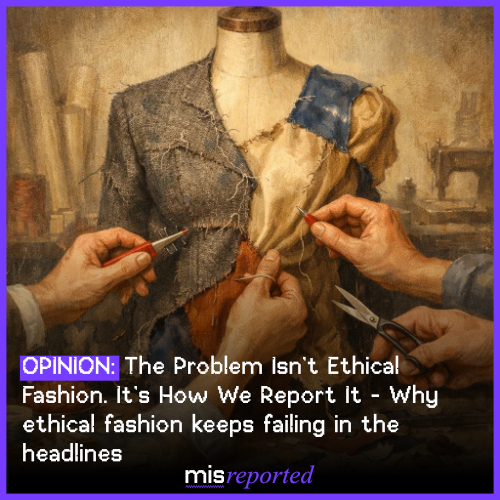
The Problem Isn’t Ethical Fashion. It’s How We Report It.
Why ethical fashion keeps failing in the headlines
When news organisations get small details wrong in stories about ethical fashion, the damage rarely looks dramatic. A material is misdescribed. A brand is placed in the wrong supply chain. A correction appears days later. The facts are fixed. On paper, the system works.
In practice, the harm is already done.
Earlier this month, The Guardian corrected two fashion stories. One clarified that Stella McCartney does use some animal products, namely wool and silk, despite avoiding leather and fur. The other removed Gap from a report on garment sourcing in Lesotho, after the company said it does not operate there.
Neither correction changed the core reporting. Stella McCartney’s finances remain under pressure. Lesotho’s garment industry remains exposed to global trade shocks. But both errors had the same effect: they reshaped how readers understood ethics, responsibility and credibility in fashion before the corrections arrived.
That is the real problem. In coverage of ethical fashion, misreporting does not just introduce inaccuracy. It distorts the moral frame of the story itself.
Fashion is no longer just about clothes. It is about values. What you buy is meant to signal care, awareness and restraint. Brands build identities around this. Journalism often mirrors that logic, presenting labels as ethical or unethical, progressive or compromised. The problem is that this framing leaves little room for how fashion actually works.
Most ethical fashion lives in the grey. It is about reduction, not elimination. Improvement, not purity. Stella McCartney’s brand has always been rooted in minimising harm within the constraints of luxury production. Presenting it as entirely animal-free made the story cleaner and more appealing, but also more fragile. Once corrected, the brand appeared to retreat from a position it never claimed.
The Lesotho story followed the same pattern from the opposite direction. Global supply chains are complex and hard to visualise. Naming a familiar Western brand brings clarity and emotional force. When that link turns out to be wrong, the correction removes the name, but not the impression formed when the story first circulated.
This is why corrections rarely undo the damage. Readers remember the first version, the one that felt morally legible. The sainted brand. The implicated corporation. By the time nuance arrives, attention has moved on.
Over time, this framing has consequences. Ethical fashion begins to look performative rather than practical. Any compromise is read as hypocrisy. Any complexity is treated as evasion. Brands are celebrated or dismissed on the basis of stories that smoothed away the trade-offs defining the industry.
None of this argues for lowering standards. Fashion deserves scrutiny, especially when ethics is part of the marketing. But scrutiny depends on precision. When journalism replaces accuracy with clarity, it may produce stronger stories, but weaker understanding.
The Guardian was right to correct its reporting. But the lesson lies upstream. Ethical fashion keeps failing in the headlines not because the industry is uniquely dishonest, but because coverage demands moral simplicity from a system built on compromise.
Until that changes, corrections will continue to arrive quietly, long after the louder version of the story has already shaped what readers believe.