

The Guardian corrects Lesotho tariffs report after misidentifying US apparel buyer
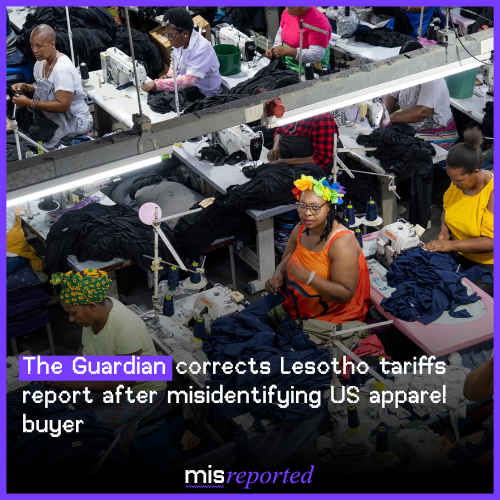
The Guardian has amended a report on the impact of US tariffs on Lesotho’s garment industry after incorrectly naming Gap as one of the American companies sourcing products from the country.
The original article examined how Donald Trump’s “reciprocal” tariffs and uncertainty over the renewal of the African Growth and Opportunity Act had intensified economic pressure on Lesotho’s export-dependent clothing sector. It described factory closures, layoffs and falling wages, using specific brand examples to illustrate the country’s integration into US supply chains. Among those examples was a reference to Gap as a company sourcing garments from Lesotho.
Following publication, Gap contacted the Guardian to state that it does not source products from the country. The paper subsequently removed the reference and appended a correction clarifying the error.
The amendment does not alter the article’s central account of declining orders, reduced factory capacity and job losses among garment workers. However, the misidentification of a major US brand matters in a story built around trade exposure and corporate linkages. Naming a well-known retailer strengthens the impression of direct dependency on US consumer brands and can amplify perceptions of both scale and culpability when policy shocks occur.
This episode reflects a recurring pattern in reporting on global supply chains, particularly in lower-income countries. Journalists often rely on emblematic multinational brands to make abstract trade relationships tangible for readers. When those associations are imprecise, even if unintentionally, they can distort the map of responsibility and influence that underpins the narrative.
The Guardian’s correction narrows the factual record by removing an unsupported claim, but it also illustrates how easily errors enter coverage produced at speed and under strong narrative momentum. In stories about trade, tariffs and development, accuracy is not confined to figures and policy descriptions. It extends to who is actually involved.
Corrections restore precision. But as with many such cases, they arrive quietly, long after the more vivid version of events has already circulated.