

When Speed Becomes the Default - What recent Corrections Reveals about Conflict Reporting
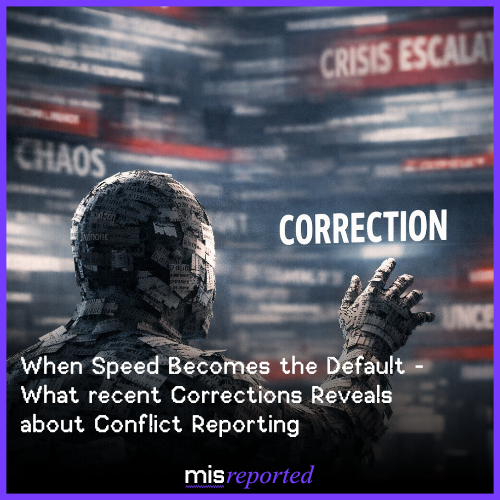
In an age of instantaneous news cycles and 24/7 conflict coverage, the quest for first often overshadows the imperative to be right. This tendency doesn’t just degrade individual stories — it reshapes how we understand violence, accountability and human suffering in some of the world’s most contested spaces. The recent correction by Al Jazeera — clarifying that a Palestinian man was critically wounded, not killed, by Israeli forces — is a stark reminder of how fragile truth can be when rush eclipses rigor.
At face value, the distinction between reporting a death and reporting a serious injury might seem technical. But in conflict reporting, that difference is everything. A death implies finality, an irreversible human loss, and in the context of a fraught and polarising war, it also becomes a symbol — of escalation, of vengeance, of humanitarian catastrophe. A serious injury elicits concern and scrutiny, but it doesn’t carry the same moral and narrative weight that a fatality does. Yet when the urgency to publish overtakes the essential discipline of verification, even experienced outlets can conflate the two.
This isn’t an isolated glitch. Across the last few years, multiple media organisations have had to amend or retract early casualty claims connected to the Israel–Palestine conflict — sometimes after those claims were circulated globally and embedded in public consciousness. The Eurovision-style scoreboard of victims and its perpetual updates feed the sense that events are spinning out of control, but too often those scores are provisional figures presented as settled facts.
What makes the Al Jazeera correction instructive isn’t that a mistake was made — mistakes happen — but that the initial report, like many before it, reflects deeper structural incentives in journalism today. Speed is rewarded with engagement, attention and clicks; context and nuance are rewarded with… quiet civil service. In war zones, where information itself becomes a battleground, the consequences of minor misstatements are magnified. Reports of who was killed, how, and why are not simple facts — they are the raw data on which governments, advocacy groups and foreign publics build their interpretations of legitimacy, victimhood and culpability.
Corrections appended later rarely travel with the same visibility as the original headlines. Once a death is reported, it takes on a life of its own in timelines, tweets and tributes long before anyone has fully verified the facts. That initial framing — even when corrected — becomes part of the story’s DNA, shaping perceptions in ways a quiet editor’s note cannot undo.
This dynamic isn’t unique to any single organisation or conflict. It reflects a broader evolution in how modern media enterprises manage uncertainty, risk and reputational exposure under fire. When provisional information is presented as definitive, the public’s understanding hardens around half-truths and incomplete narratives. And in a world already primed for conflict anxiety, such misframing not only misinforms — it amplifies dread and entrenches division.
If journalism’s role is to clarify rather than inflame, its practitioners must resist the gravitational pull of immediacy. A correction like Al Jazeera’s may seem small, but its implications are not. It highlights the essential tension at the heart of contemporary reporting: between what is possible to publish right now and what is responsibly accurate to publish at all.
As audiences, we are increasingly sceptical — and arguably for good reason. But we must also recognise that true accountability in journalism isn’t measured by a correction appended after the fact. It’s measured by the discipline to verify before publication, the willingness to pause coverage rather than propagate uncertainty, and the commitment to uphold the full nuance of human experience — especially in conflicts where every word counts.