

BBC corrects Holocaust Memorial Day wording after omitting Jews from death toll
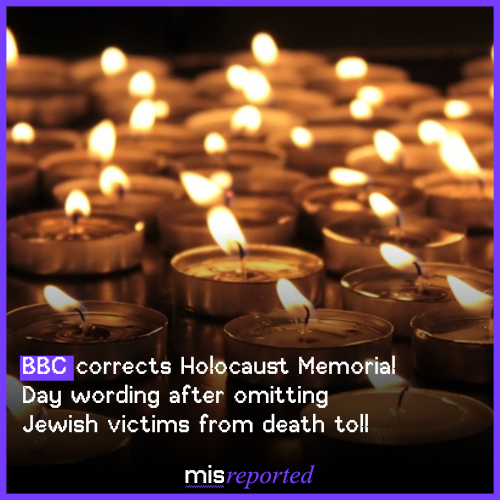
BBC has issued a correction after repeatedly misstating the central historical fact of the Holocaust during its coverage of Holocaust Memorial Day across Radio 4’s Today programme, BBC Breakfast and the BBC News Channel.
In multiple bulletins on 27 January, presenters and scripts referred to “six million people” or “six million mostly Jewish people” murdered by the Nazi regime. The BBC has acknowledged that both formulations were wrong. The correct phrasing, it said, should have been “six million Jewish people”.
This is not a semantic quibble. The systematic murder of six million Jews is not a general statistic about wartime loss, nor a demographic approximation. It is the defining fact of the Holocaust itself. To describe the victims as “people” or “mostly Jewish people” blurs the specificity of a genocide that was explicitly ideological, racial and targeted. It collapses intent into abstraction.
The error is striking precisely because Holocaust Memorial Day exists to guard against that kind of erosion. Language is not incidental in this context. Precision is the point. Substituting a universal category for a specific one risks recasting the Holocaust as an episode of mass death rather than the attempted annihilation of the Jewish people.
The BBC’s apology recognises the mistake, but the breadth of the miswording across multiple flagship outlets suggests a systemic failure rather than a single slip of the tongue. These were prepared scripts, repeated across platforms, on a day devoted to remembrance. That makes the error harder to dismiss as incidental.
As with many institutional corrections, the clarification arrives after the coverage has aired and the moment has passed. Viewers and listeners who heard the original phrasing would have absorbed a softened version of the historical record at precisely the moment when clarity matters most. The correction restores accuracy, but it cannot rewind the broadcast.