

BBC News corrects statement on coroner finding in Swindon death coverage
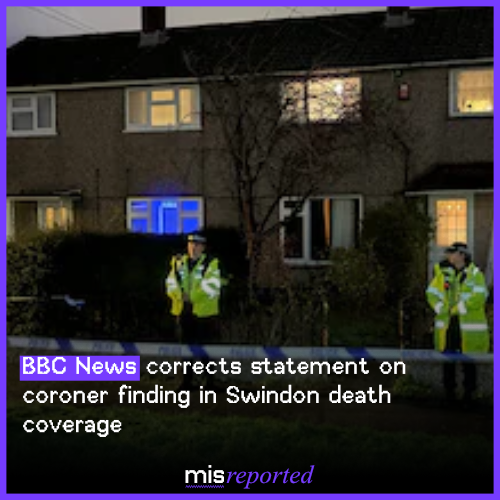
The BBC has amended a report concerning the death of Sarah Forrester in Swindon to clarify that no coroner’s ruling had been made on the cause of her death. A correction appended to the article stated that an earlier version had incorrectly reported that the coroner had ruled the death “inconclusive”. The revised version removes that claim, noting instead that the cause of death remained unexplained and under investigation by police.
The original wording implied that the coroner had already assessed the circumstances of Ms Forrester’s death and reached a provisional or formal conclusion, albeit an indeterminate one. In the context of an ongoing police investigation, the reference to an “inconclusive” ruling suggested a completed procedural step within the medico-legal process. Readers could reasonably infer that a post-mortem examination and coroner’s consideration had taken place and failed to identify a cause.
In practice, the distinction between an unexplained death and an inconclusive coroner’s ruling is material. An unexplained death indicates that the investigation remains open, with no authoritative determination yet made. An inconclusive ruling, by contrast, implies that an examination has been conducted but has not yielded definitive answers. By attributing a conclusion to the coroner prematurely, the original report compressed the timeline of investigative and judicial processes, potentially overstating how far the case had progressed.
This misstatement also had implications for how accountability and uncertainty were framed. The article already reported that a 13-year-old girl had been arrested on suspicion of murder and released on bail, while police emphasised that no one else was being sought and that the public should not speculate. Introducing an erroneous reference to a coroner’s ruling risked creating a false sense of procedural closure alongside an active criminal inquiry, blurring the separation between investigative stages that are deliberately distinct.
Corrections of this kind are particularly significant in reporting on deaths subject to police investigation. Media outlets often rely on incremental updates from law enforcement and judicial authorities, and small inaccuracies can arise when those updates are interpreted too expansively. In this case, the correction narrowed the report back to what had actually been confirmed by officials, rather than what might have been assumed to follow.
Precision matters acutely in coverage involving unexplained deaths, arrests of minors, and ongoing criminal investigations. The language used to describe forensic and legal processes shapes public understanding of what is known, what is uncertain, and what remains to be established. By correcting the record, the BBC has acknowledged the importance of distinguishing between an absence of explanation and a formal finding, a distinction that is central to maintaining clarity and confidence in reporting on sensitive and unfinished cases.
BBC News corrected its reporting on the death of Sarah Forrester, clarifying that no coroner’s ruling had been issued on the cause of death. The original framing suggested that the coroner had already found the death to be inconclusive, which materially altered how readers would interpret the stage and status of the investigation. That distinction matters, and misframing it risks undermining public trust, inflating narratives, or distorting accountability.