

CNN corrects global health funding report after misstatement on US aid reductions
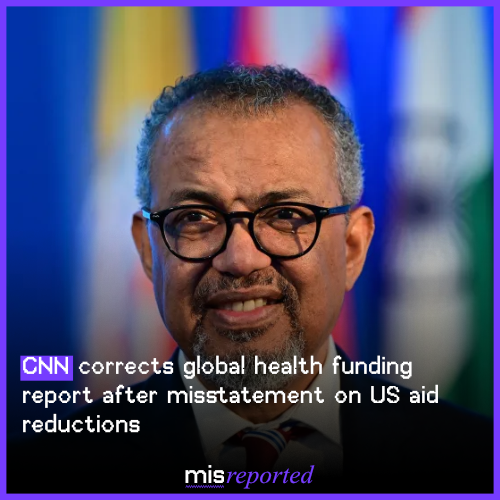
CNN corrects global health funding report after misstatement on US aid reductions
CNN has amended a report on new pledges to combat polio worldwide after misstating the scale and status of US funding cuts, issuing a correction clarifying that an earlier version inaccurately described reductions in American support. The correction, appended after publication, acknowledged an error in how US funding decisions were characterised within the broader narrative of shrinking donor commitments.
The original article reported on a $1.9 billion funding pledge announced in Abu Dhabi for the Global Polio Eradication Initiative, while emphasising what it described as a stark funding gap driven by donor retrenchment, particularly among high-income countries. In that framing, US policy choices featured prominently as part of a wider pullback, reinforcing a sense that the eradication effort was being undermined by abrupt and settled decisions in Washington.
Following correction, the picture is more qualified. While the United States has made significant changes to its global development architecture and has halted some forms of cooperation, funding for polio itself continues to receive bipartisan congressional support, with fiscal year 2025 funding holding steady and uncertainty remaining over 2026 rather than confirmed cuts. That distinction alters the balance of responsibility implied in the original version.
Before amendment, readers could reasonably conclude that US disengagement was already a concrete driver of the remaining funding gap. The corrected version instead places the uncertainty firmly in the future, alongside reductions by other donors and a more general tightening of aid budgets. This is not a marginal clarification: it changes whether shortfalls are understood as the result of completed political choices or unresolved budgetary debates.
The episode illustrates a familiar pattern in global health reporting, where urgency and advocacy can compress nuance. The fight against polio is routinely framed as being “on the brink” of success, a formulation that heightens the moral stakes but also increases the temptation to overstate causality when funding risks emerge. In such contexts, provisional figures and conditional policy signals can harden prematurely into definitive claims.
That matters because global health financing depends on confidence as much as commitment. Donor governments, implementing agencies and partner countries all operate within multi-year planning cycles that are sensitive to perceptions of retreat or instability. Reporting that implies settled withdrawal where there is ongoing negotiation risks distorting those calculations, however inadvertently.
CNN’s correction restores factual accuracy on a specific point, but it also highlights how quickly complex budgetary realities can be simplified in pursuit of a clear narrative. In global health, where progress is incremental and funding decisions are layered, precision is not pedantic. It is central to understanding whether setbacks are political, cyclical or structural.
As eradication campaigns approach their final stages, the margin for error narrows. So does the tolerance for mischaracterisation. Corrections repair individual statements, but trust rests on whether initial framing gives readers a clear sense of what is known, what is decided and what remains uncertain.