

The Financial Times corrects senior opposition role after promotion error
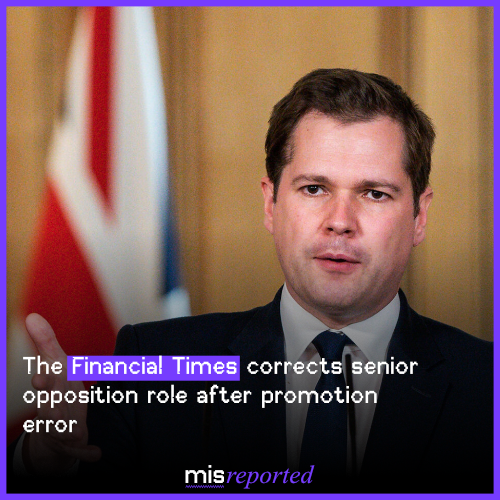
The Financial Times has issued a correction after misidentifying Robert Jenrick’s shadow cabinet position in a newspaper promotion for FT Weekend that appeared on December 5. The promotion incorrectly described Mr Jenrick as the UK’s shadow chancellor; he is in fact the shadow secretary of state for justice.
The error concerned a high-profile politician holding one of the most senior opposition roles, and appeared not in a reader comment or peripheral reference, but in a prominently placed editorial promotion. Such a mistake is notable precisely because the distinction between the shadow chancellor and the justice brief is neither obscure nor technical. It is a basic element of current British political structures, readily verifiable and widely understood among FT readers.
Prior to the correction, the misstatement risked confusing readers about the internal balance and economic messaging of the opposition front bench. The shadow chancellor role carries a specific weight in shaping fiscal policy, market positioning and political signalling. Assigning that title incorrectly alters how statements and affiliations might be interpreted, particularly in the context of FT Weekend content, which often intersects with economic and policy debates.
The correction clarifies the factual record, but the nature of the mistake invites wider scrutiny. Misidentifying the portfolio of a senior figure suggests that the material was prepared, approved and published under time pressure, with verification treated as secondary to production deadlines. Unlike errors involving complex data or fast-moving events, this was a static fact about an individual whose role has been unchanged for some time.
Such slips illustrate how haste increasingly affects even established newsrooms with rigorous standards. Promotions, newsletters and headline summaries are often produced on compressed timelines, yet they shape reader perception as directly as reported articles. When errors occur at this level, they signal not a lack of knowledge but a breakdown in basic checks.
The Financial Times corrected the error promptly, reinforcing its accuracy obligations. Still, the episode underscores that misreporting does not always arise from contested interpretation or emerging information. Sometimes it stems from speed alone. In political reporting especially, where titles and offices carry institutional meaning, even small inaccuracies can distort understanding.
Precision in attribution and role description is foundational, not optional. When errors involve figures at the top of public life, they are more than typographical slips. They reveal how editorial haste can intrude even where the underlying facts are straightforward.