

The New York Times corrects abortion statistics in coverage of Illinois clinic hub
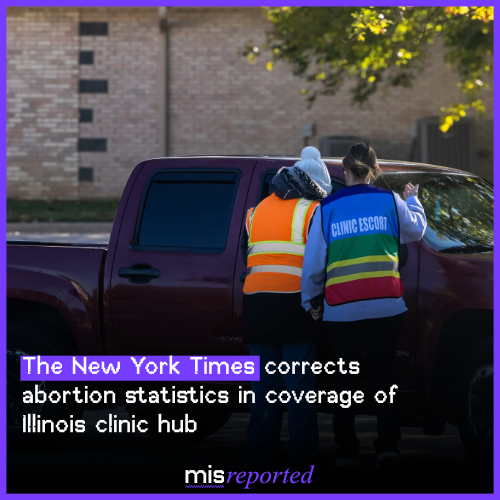
The New York Times has issued a correction to a front-page feature on how Carbondale, Illinois, has become a major centre for abortion access following the Supreme Court’s reversal of Roe v. Wade, after misstating a key national statistic on abortion provision in the United States.
The article, published on December 7, examined how three clinics in the city of 21,000 residents provided nearly 11,000 abortions in the past year, largely to women travelling from neighbouring states with restrictive abortion laws. In situating Carbondale’s experience within a national framework, however, the report incorrectly stated that there were 1,038,100 clinician-provided abortions nationally in 2024.
A correction appended to the article clarifies that this figure referred only to abortions performed in states without total abortion bans, not to the national total. The original wording therefore understated the overall number of procedures across the country and mischaracterised the distribution of abortion access in the post-Dobbs landscape.
Before the correction, readers were left with the impression that abortion provision had contracted more sharply nationwide than the data supports, a framing that carries particular weight in a debate where statistics are frequently used to signal moral, political and legal consequences. The difference between “national” figures and those limited to specific legal jurisdictions is not technical but substantive, shaping how readers understand both scale and policy impact.
The error highlights a recurring vulnerability in long-form explanatory journalism: the compression of complex datasets into a single, narrative-friendly figure. Abortion data in the United States is highly fragmented, varying not only by state law but by reporting standards and methodology. Losing a qualifier in that context does not merely simplify the picture; it changes it.
The Times corrected the mistake in line with established practice. Yet the placement and timing of the correction underscore a familiar asymmetry. The original statistic anchored a widely read narrative about access, geography and political consequence. The clarification arrived only after that framing had already circulated.
This episode mirrors a broader pattern seen across recent reporting, from national security stories later softened by inquiry findings, to foreign affairs coverage amended after basic geographical or factual errors came to light. In each case, the core reporting often remains intact, but small inaccuracies subtly reshape public understanding before they are corrected.
In the abortion debate, where questions of access, prevalence and impact are intensely contested, precision is not incidental. Numbers do not merely support narratives; they define their boundaries. When those numbers are wrong, even briefly, the narrative shifts with them.
Corrections restore accuracy. But in highly politicised reporting environments, they also serve as reminders that speed and scope can outpace verification, even at the most established outlets.