

The Guardian corrects war-crimes claim in report on Israeli comedian’s detention
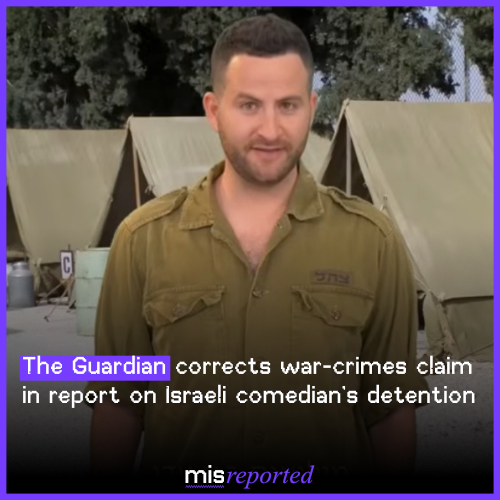
The Guardian has amended an article about the brief detention of Israeli comedian Guy Hochman in Canada after quietly removing a serious allegation that should never have been published in the first place.
The original report stated that a dossier submitted by the Hind Rajab Foundation included evidence of Hochman’s participation in the destruction of a mosque in Rafah in September 2024. That claim was later withdrawn by the foundation itself, which acknowledged that the individual in question was not Hochman. The Guardian subsequently amended its article to reflect this retraction, deleting references to the allegation.
This was not a marginal error or a matter of interpretation. It was a specific, incendiary factual claim tied to an accusation of war crimes, published without adequate verification and only corrected after the source organisation reversed itself. In any other context, alleging participation in the destruction of a religious site during wartime would demand the highest evidentiary threshold. Here, it was presented as part of a rolling narrative and then quietly excised.
The episode exposes a recurring problem in the paper’s coverage of Israel-related stories: the willingness to amplify the most severe accusations at speed, while treating corrections as an administrative afterthought. The amended note appears at the bottom of the article, long after readers would have absorbed the original charge. There is no recalibration of tone, no acknowledgment of the gravity of publishing an allegation that turned out to be false, and no reflection on how such claims shape public perception even after being withdrawn.
What makes the error especially troubling is that it was not peripheral to the story. The allegation went directly to the moral and legal case being constructed around Hochman’s detention. Removing it does not merely tidy up the record; it materially weakens the justification implied by the original reporting. Yet the structure of the article remains intact, as though nothing fundamental has changed.
Corrections exist to restore accuracy. But when they follow claims of this magnitude, issued so discreetly, they do little to undo the damage. In this case, the Guardian was not correcting a misheard quote or a misplaced date. It was retracting an untrue allegation of involvement in the destruction of a mosque during a live war. That should prompt more than a line at the bottom of the page.