

The New York Times corrects figures in reporting on historians’ push to condemn Israel
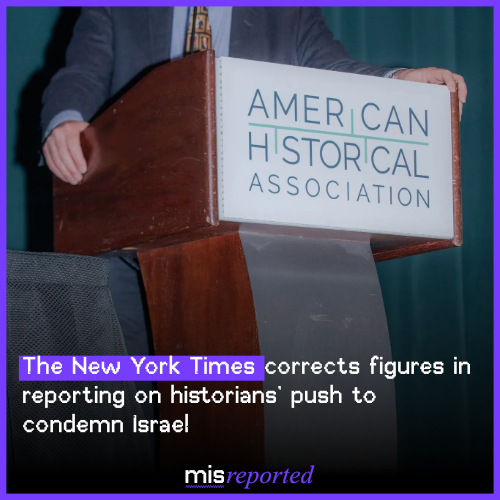
The New York Times has issued corrections to an article reporting on the American Historical Association’s decision to veto two member-approved resolutions critical of Israel’s actions in Gaza, after misstating both attendance figures and overall membership size.
The original report stated that almost 500 members attended the vote at the association’s annual conference and that the organisation had roughly 14,000 members. In fact, about 360 members were present for the vote, and the association’s total membership stands at approximately 11,000. The Times appended corrections clarifying both figures after publication.
While the numerical errors do not alter the core account of the executive council overriding resolutions passed by conference attendees, they materially affect how representative the vote appears. Presenting the meeting as larger than it was risks exaggerating the breadth of member participation, particularly in a dispute centred on internal democracy, mandate and legitimacy within a professional body.
The episode is also notable because the article addressed questions of institutional authority, procedural boundaries and reputational risk. In that context, precise figures matter. Whether resolutions passed by 360 members or nearly 500 shapes perceptions of how much weight leadership was deflecting when it intervened, and how narrow or broad the constituency behind the measures actually was.
The Times also corrected the name of the sponsoring group, initially misidentifying Historians for Peace and Democracy. That error, while modest, further illustrates how easily accuracy can slip in coverage of politically charged academic disputes, particularly those touching on Israel and Gaza, where language, scale and attribution are closely scrutinised by all sides.
Taken together, the corrections underscore a recurring pattern in sensitive institutional reporting. The framing may be directionally correct, but small factual inaccuracies can skew readers’ understanding of proportionality, representation and power. In debates already defined by contested legitimacy, precision is not incidental; it is central to how authority and dissent are interpreted.