

The Times corrects headline on Europe’s electric car “slowdown” after clarification on growth
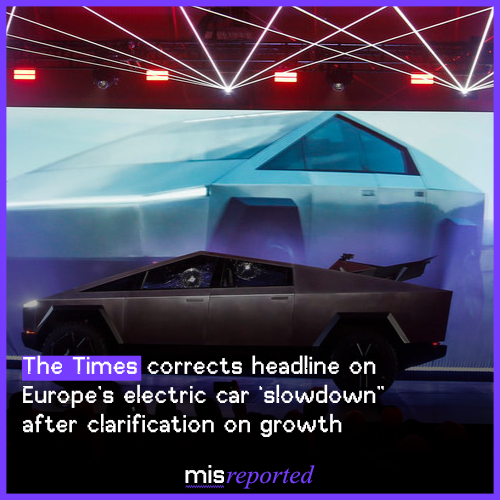
The Times has amended a headline accompanying its coverage of Tesla’s weakening European sales, after acknowledging that its wording implied a continent-wide slump in electric vehicle demand that the underlying data did not support.
The original headline referred to a “slowdown” in Europe’s electric car market. But the newspaper later clarified that, as the article itself set out, electric vehicle sales across Europe are rising, just not at a pace that industry bodies consider sufficient to meet environmental targets. The correction cited the European Automobile Manufacturers Association’s position that growth is continuing, albeit too slowly for the transition timetable.
The distinction is not semantic. A “slowdown” suggests contraction or reversal: a market losing momentum in absolute terms. “Growing too slowly” describes a different dynamic: demand is increasing, but the trajectory is falling short of what policymakers and manufacturers say is required. Conflating the two changes how readers interpret the broader market context in which Tesla’s performance is being assessed.
That matters because the article’s core reporting focused on Tesla’s sharp drop in EU and wider European registrations, with possible explanations ranging from model refresh timing to intensifying Chinese competition and brand sensitivity around Elon Musk. Those are company-specific factors. A headline implying a wider market retreat risks smearing a structural narrative over what is, in the first instance, a Tesla story, and can lead readers to assume the decline reflects shrinking appetite for EVs overall.
Headlines do disproportionate work in business reporting. They are often the only part of a story that travels widely through social media, newsletters and trading chats, particularly when the subject is a bellwether stock and a politically charged consumer product. In that environment, a subtle but meaningful misframe can harden quickly into received wisdom: that Europe has “fallen out of love” with EVs, rather than that adoption is rising but undershooting the required curve.
The correction brings the framing back into alignment with the article’s substance. It also illustrates a common misreporting pattern in transition-era coverage, where the most clickable narrative is not that change is happening, but that it is stalling. Yet the more accurate interpretation is often messier: progress, friction and target gaps, all at once.
In climate and industrial transition stories, that difference is the argument. Whether Europe is experiencing an EV retrenchment or an EV ramp-up that is insufficient carries very different implications for manufacturers, regulators and investors. When a headline collapses that nuance, it does not just misdescribe the market. It misleads readers about the direction of travel.