

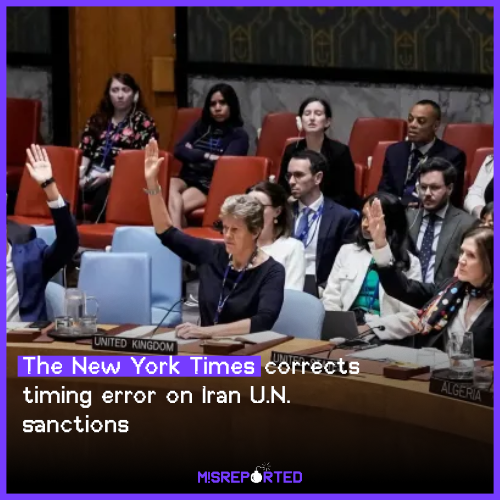
The New York Times corrects timing error on Iran U.N. sanctions
The New York Times has issued a correction to its Sept. 27 report, “Iranians Brace for Economic Impact of New U.N. Sanctions,” after misstating when the Security Council’s “snapback” measures would take effect.
The paper originally told readers the reimposition was set for Sunday. Its amendment clarifies the sanctions were due Saturday, not Sunday: “An earlier version of this article misstated when sanctions were set to be reimposed on Iran. They were set to take effect on Saturday, not Sunday.”
The Guardian admits error in BP energy outlook coverage
The Guardian has corrected a key mistake in its reporting on BP’s annual energy outlook, after misquoting figures on future gas demand in a way that risked trivialising the scale of the challenge.
In its 26 September article, “BP suggests net zero will not be met as it raises oil targets,” the paper wrote that natural gas demand could reach 4,806 cubic metres a year in 2050, up from a previous estimate of 4,729 cubic metres. The correct figures, as later acknowledged, were 4,806 billion cubic metres and 4,729 billion cubic metres.

BBC Gaza documentary draws criticism for selective reporting on aid theft claims
The BBC’s latest Panorama investigation, Gaza: Dying for Food, has been accused of misrepresenting Israeli claims about Hamas diverting humanitarian aid, after relying heavily on UN assurances that no systemic theft has taken place.
The program, which was unable to film inside Gaza itself and instead relied on local Palestinian filmmakers, cited an August report by the Integrated Food Security Phase Classification (IPC) that alleged famine conditions, a finding Israel has dismissed as “an outright lie”.
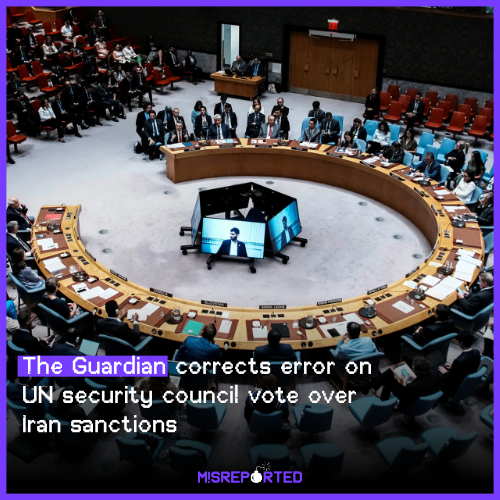
The Guardian corrects error on UN security council vote over Iran sanctions
The Guardian has acknowledged an error in its recent coverage of United Nations sanctions against Iran, underscoring how imprecision in reporting can skew the debate on one of the world’s most sensitive security issues.
In its September 20 article, “UN security council fails to prevent ‘snapback’ nuclear sanctions on Iran,” The Guardian originally stated that the UN security council had nine members. The paper later clarified that the council has 15 members, and that a resolution requires the affirmative votes of at least nine for passage.
Semafor clarifies error in reporting on Gulf safety survey
Semafor has corrected a recent report on perceptions of safety in the Gulf, after initially mischaracterising the nature of Gallup’s findings.
The original article highlighted Gallup’s latest global survey, which placed five Gulf countries among the world’s top 10 for feeling safe while walking alone at night. The UAE was singled out as a regional outlier where women reported feeling marginally safer than men, though the difference across the Gulf was small.
NPR corrects autism report after overstating prevalence figures
NPR has issued a correction to its coverage of the White House announcement on acetaminophen and autism after misstating the prevalence of the condition.
In its original broadcast, the outlet reported that 1 in 3 children were diagnosed with autism. In fact, the correct figure is 1 in 31, or roughly 3%. The mistake was later clarified in an editor’s note attached to the segment.
Politico corrects Macron article after misnaming French president
Politico has issued a correction to its coverage of Emmanuel Macron’s weekend interview on CBS’s Face the Nation. An earlier version of the article gave the French president’s first name and title incorrectly. The slip itself is minor. But as with so much reporting around Israel and Palestine, even small errors carry weight because they highlight the way language, framing and credibility are all scrutinised.
The original piece described Macron’s defence of France’s recognition of Palestinian statehood, setting it in the context of the war in Gaza and heavy criticism from Washington. While Politico corrected his name and title, what went unexamined was the framing of Macron’s remarks. By presenting recognition as the “only” route to peace, the article risked glossing over Hamas’s role and the hard security realities Israel continues to face.
The Telegraph issues significant correction: Kremlin ties story collapses under scrutiny
The Telegraph has issued a significant correction to a June article headlined “Trump official who shut down counter-Russia agency has links to Kremlin”. The story had claimed that Sergei Chernikov — and by extension his niece, Yulia Kirillova — maintained active ties to the Kremlin and to President Vladimir Putin. The paper now concedes this was false.
In reality, neither Chernikov nor Kirillova has any association with the Kremlin or with Putin. Chernikov has lived outside Russia since 2008 and has not returned since 2020. The Telegraph also wrongly described him as a former Deputy Governor of the Nenets region in Siberia, and further alleged he had received a personal note of thanks from Putin during the 2000 election campaign — both claims now acknowledged to be untrue.
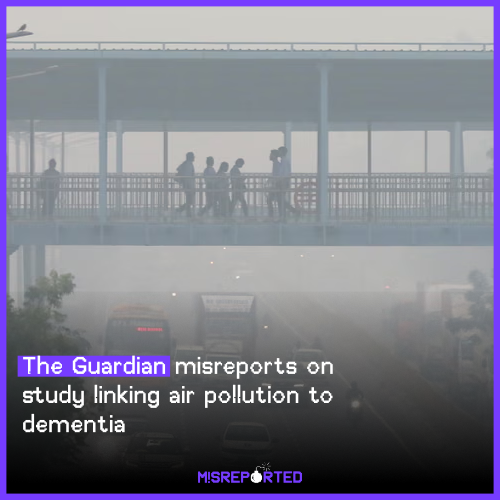
The Guardian misreports on study linking air pollution to dementia
The Guardian recently ran a story on new scientific research that connects fine-particulate air pollution to Lewy body dementia, but its framing risks overstating certainty while downplaying context.
The study, led by researchers at Johns Hopkins University, examined data from 56.5 million US Medicare patients alongside controlled experiments in mice. It suggested that long-term exposure to PM2.5 particles — airborne matter smaller than 2.5 thousandths of a millimetre — could trigger misfolding of alpha-synuclein proteins in the brain, producing toxic clumps known as Lewy bodies. These are a hallmark of Lewy body dementia, the third most common form of dementia after Alzheimer’s disease and vascular dementia.
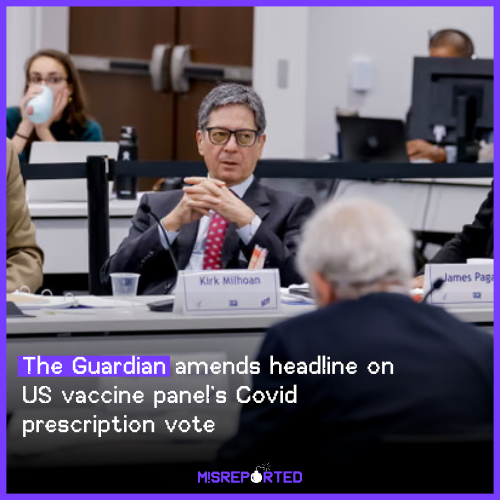
The Guardian amends headline on US vaccine panel’s Covid prescription vote
The Guardian has amended a headline on its 19 September coverage of a US vaccine policy meeting after misrepresenting the committee’s role in Covid vaccine prescriptions.
The original headline suggested that the CDC’s Advisory Committee on Immunization Practices (ACIP) had removed the need for a prescription to obtain the vaccine. In fact, the panel narrowly voted against recommending that a prescription should be required – a distinction that matters, given that the committee has no authority to alter prescription rules.
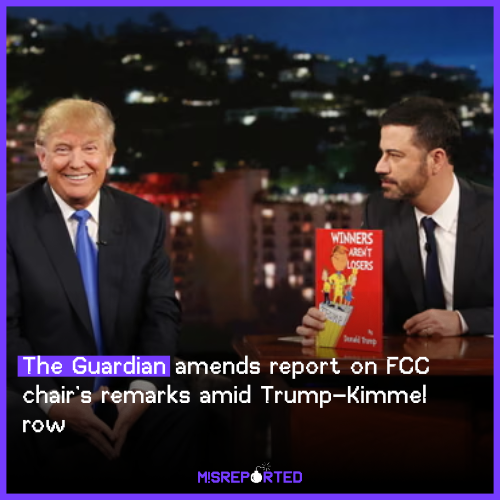
The Guardian amends report on FCC chair’s remarks amid Trump–Kimmel row
The Guardian has amended coverage of the suspension of Jimmy Kimmel’s late-night show, after wrongly stating that US Federal Communications Commission (FCC) chair Brendan Carr had raised censorship concerns during an appearance on The Bulwark podcast.
In fact, Carr’s comments were made in an interview with conservative commentator Scott Jennings.
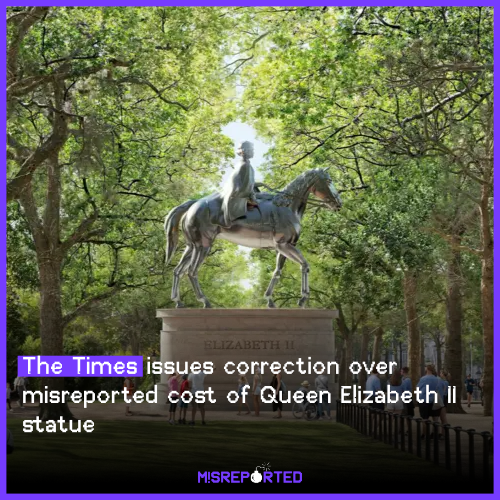
The Times issues correction over misreported cost of Queen Elizabeth II statue
The Times has issued a correction after it incorrectly reported that a statue of Queen Elizabeth II would cost up to £46 million and be unveiled next year.
In fact, as the paper clarified, the £46 million figure refers to the overall budget for the memorial site in St James’s Park. The designs for the site are not yet complete and are only due to be finalised next year.
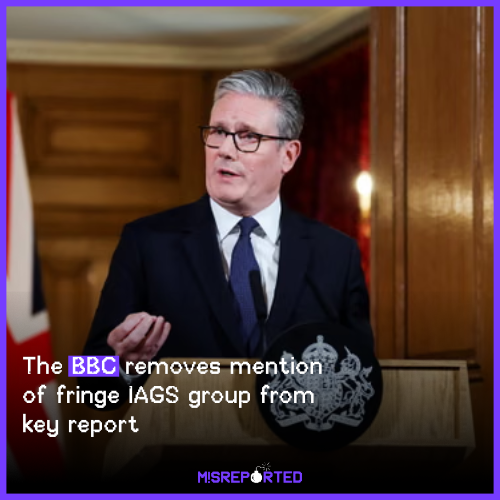
The BBC removes mention of fringe IAGS group from key report
This morning, the BBC published a piece on the UK Government’s recognition of Palestine.
The report mentioned input from the International Association of Genocide Scholars (IAGS) on the contested debate over Israel’s military campaign in Gaza.
Originally published at 06:04am BST, the report was soon updated at 08:54am to fully remove the reference to IAGS, which has accused Israel of committing genocide.
Wall Street Journal forced to correct error in BBVA–Sabadell valuation coverage
The takeover battle between Spain’s BBVA and Banco Sabadell has been closely scrutinized by investors, regulators and retail shareholders alike. Yet a small numerical error in reporting by the Wall Street Journal shows how even minor inaccuracies can mislead markets during such high-stakes deals.
The paper initially reported that BBVA’s previous offer terms valued Sabadell shares at €3.14 based on Friday’s closing prices. In fact, the correct figure was €3.08. The correction was later issued at the foot of the article.
CNN report on Palestinian recognition omits key context and leans on disputed claims
A lengthy CNN feature on the recognition of Palestinian statehood by the United Kingdom, Canada and Australia presents a highly partial narrative that risks misleading readers on several critical points.
The article, headlined “Western recognition won’t change the reality on the ground: A Palestinian state has never seemed further away” (17 September 2025), highlights international momentum for recognition but fails to address the longstanding record of Palestinian Authority (PA) corruption and incitement, including its “pay-for-slay” policy of financially rewarding convicted terrorists and their families. This omission is striking given that the piece presents recognition as a straightforward act of justice and legitimacy, while ignoring behaviors that directly undermine peace prospects.
The Guardian correction exposes misleading framing of UN inquiry on Israel
The Guardian has amended an opinion piece that originally implied the United Nations itself had formally accused Israel of genocide in Gaza. In reality, the finding cited came from an independent UN commission of inquiry — not from the UN as a whole.
The correction, added on 18 September 2025, stated: “A previous version of the headline incorrectly implied that the UN’s independent international commission of inquiry spoke on behalf of the UN.”
The Guardian correction highlights misleading framing of protest coverage
The Guardian has amended an article on policing of Gaza-related demonstrations after incorrectly referring to the Equality and Human Rights Commission (EHRC) as “the UK’s” human rights watchdog. In fact, the EHRC covers only England, Scotland and Wales, not Northern Ireland.
The correction was quietly added on 19 August 2025, with the headline and main text both altered.
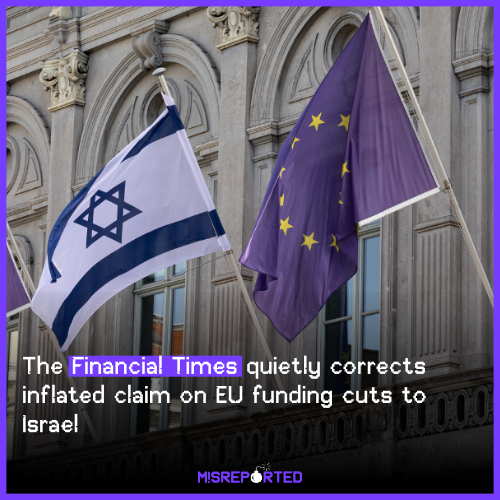
FT quietly corrects inflated claim on EU funding cuts to Israel
The Financial Times has amended an article after wrongly reporting that the European Commission planned to suspend €14bn worth of funding for projects in Israel. The actual figure, confirmed by the Commission, was €14mn.
The original piece, published on 11 September, stated that billions of euros in support would be frozen. In fact, the Commission announced the suspension of €14mn for “institutional co-operation projects” alongside a pause on a smaller tranche of regional funding.
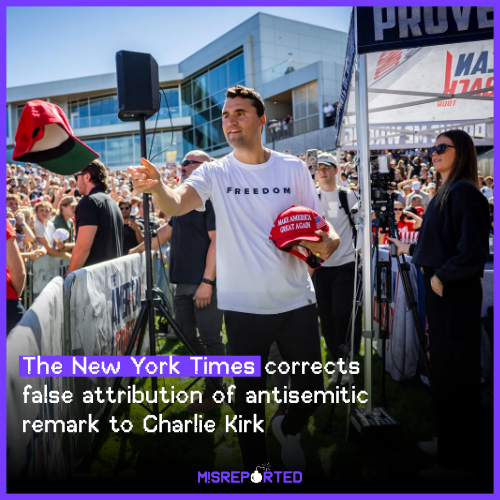
The New York Times corrects false attribution of antisemitic remark to Charlie Kirk
The New York Times has been forced to correct an article that wrongly attributed an antisemitic statement to conservative activist Charlie Kirk.
The article, Where Charlie Kirk Stood on Key Political Issues, claimed Kirk himself had made the remark during an episode of his podcast. In fact, he was quoting from a social media post — one amplified by Elon Musk — before going on to criticise it.
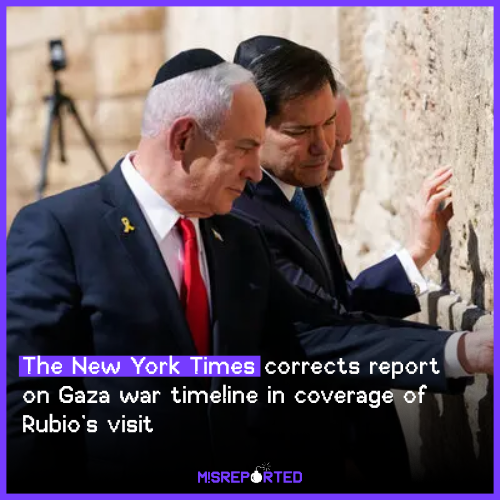
The New York Times corrects report on Gaza war timeline in coverage of Rubio’s visit
The New York Times has amended its reporting on Secretary of State Marco Rubio’s trip to Israel after misstating the length of the conflict in Gaza.
An article published on 13 September said that the war had been raging for nearly three years. In fact, the fighting began nearly two years ago. The correction was appended to a piece describing Rubio’s consultations with Israeli officials over their planned military offensive in Gaza City and President Trump’s frustrations with Prime Minister Benjamin Netanyahu’s approach to the conflict.