


Bloomberg corrects report on China’s next five-year plan timeline
Bloomberg has issued a correction to its reporting on European business concerns in China after misstating the years covered by Beijing’s upcoming five-year plan.
An article published on 17 September initially gave the wrong timeframe for the plan, which will chart China’s economic development strategy from 2026 to 2030. The piece focused on calls by the European Union Chamber of Commerce in China for Beijing to rein in damaging price wars, stimulate domestic consumption and ease trade frictions linked to rare earth export controls.

Australian Broadcasting Corporation amends report on melatonin sales suspension after misattributing overdose data
The Australian Broadcasting Corporation has issued a correction to its 29 August coverage of melatonin sales in Australia.
The original article reported that US-based retailer iHerb suspended sales of melatonin supplements to Australia following “an increase in calls to the WA poisons hotline” and a rise in cases of paediatric overdose. The story has since been updated to clarify that iHerb did not confirm whether the Western Australia Poisons Information Centre’s data influenced its decision to halt sales.

The Telegraph clarifies visa report after overstating arrivals under ‘global talent’ scheme
The Telegraph has amended a report that overstated the scale of Britain’s “global talent” visa route for creatives.
An article published on 25 August, headlined “Taxpayer-funded company helps foreign artists secure visas for £100”, initially suggested that 948,000 people had entered the UK on global talent visas by the end of 2024. In fact, as the body of the piece made clear, the figure refers to the total number of legal arrivals to the UK during that period across all visa categories, of which the global talent route is only a small contributor.
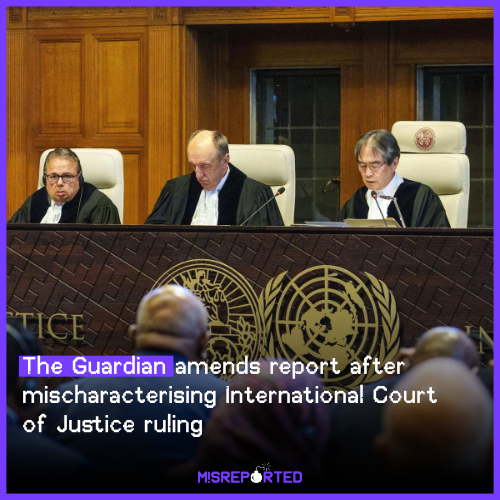
The Guardian amends report after mischaracterising ICJ ruling
The Guardian has issued another correction concerning its reporting on the International Court of Justice (ICJ) and proceedings over Israel and Gaza.
In a 5 September article by Beirut correspondent William Christou, the paper stated that the ICJ had ruled in January 2024 that the claim of genocide was “plausible”. This language has been widely misreported in international coverage but is not an accurate reflection of the court’s decision.

Politico corrects report on GOP megabill after misstating Republican opposition
Politico has corrected its coverage of Senator Susan Collins’ remarks on President Donald Trump’s sweeping tax and spending package, after initially misstating the number of Republicans who voted against the so-called “megabill.”
The article, published September 15, recounted Collins’ criticism of the legislation’s cuts to Medicaid and rural health care, as well as her defence of ousted CDC director Susan Monarez. But it also asserted the wrong number of Republicans had opposed the bill, requiring an amendment after publication.
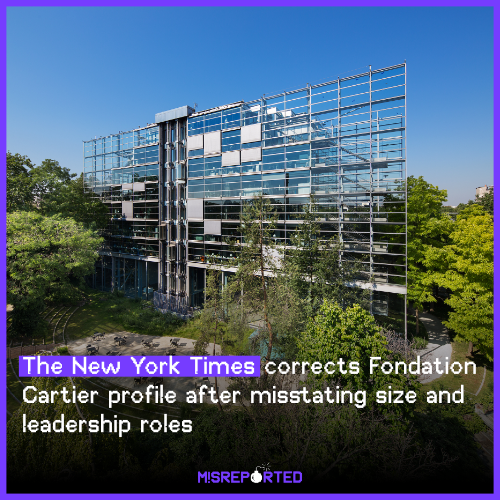
The New York Times corrects Fondation Cartier profile after misstating size and leadership roles
The New York Times has issued a correction to its profile of Chris Dercon, managing director of the Fondation Cartier, after misstating two basic but significant details: the size of the institution’s new Paris home and the position of its president.
The article, published on September 15, initially described the new building opposite the Louvre as 86,000 square feet. In fact, it is 91,500. It also incorrectly identified Alain Dominique Perrin as the Fondation Cartier’s director rather than its president.

Bloomberg amends JPMorgan-Plaid report after misstating date of joint statement
Bloomberg has corrected its reporting on JPMorgan Chase & Co.’s updated data-sharing agreement with Plaid Inc., after initially misstating the date of the joint statement between the two companies.
The article, published on August 26, detailed how the banking giant and the fintech agreed on a new pricing structure for consumer data requests — a move with significant implications for the future of open banking in the United States. But at the foot of the report, Bloomberg quietly noted that an earlier version had the date of the joint statement wrong.
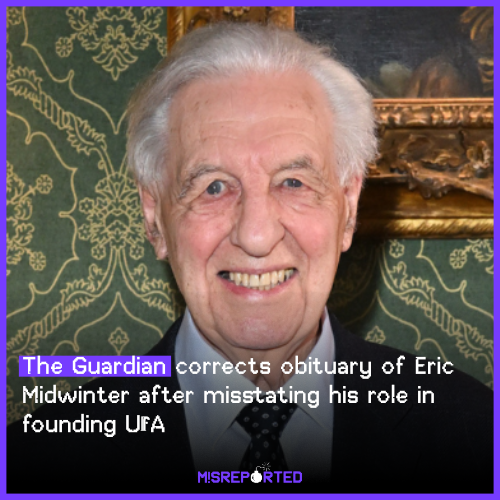
The Guardian corrects obituary of Eric Midwinter after misstating his role in founding U3A
The Guardian has amended its obituary of Eric Midwinter, the educationist and writer who died in August aged 93, after misstating his role in the origins of the University of the Third Age (U3A).
The original obituary, published on August 30, stated that Midwinter co-founded the international U3A in 1992. In fact, he was among the founders of the UK movement in 1982, drawing on a model first developed in France in the 1970s.
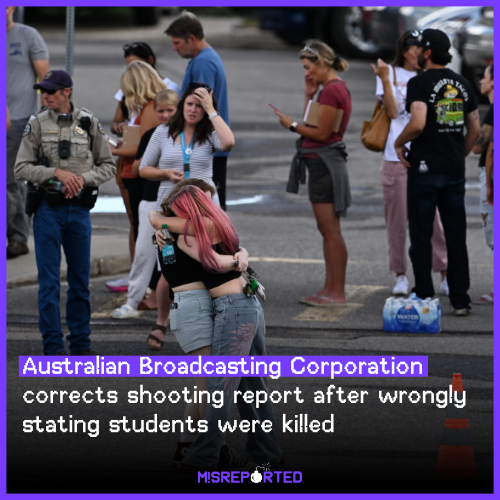
Australian Broadcasting Corporation corrects Evergreen High School shooting report after wrongly stating students were killed
The Australian Broadcasting Corporation has issued a correction to its reporting on the September 12 Evergreen High School shooting in Colorado, after initially stating that two students had been killed by the gunman. In fact, the students were injured, not fatally shot.
The original article appeared as part of an online analysis linked to the killing of conservative activist Charlie Kirk. In its first version, the report said the shooter had opened fire on fellow students at Evergreen High, killing two before turning the gun on himself. That account has now been amended to clarify that while two students were targeted, they survived.

The Guardian amends eyewear guide after failing to note free eye tests in Scotland
The Guardian has issued a correction to its consumer advice coverage after a guide to buying glasses neglected to mention that eye tests are free in Scotland.
The article, published on August 30 under the headline Is spending more better for your eyes?, compared the costs of spectacles, frames and enhanced eye exams across the UK. It provided guidance on NHS vouchers, employer subsidies and online savings but omitted the detail that all residents of Scotland are entitled to free eye tests. That fact was added in an amendment published on September 4.
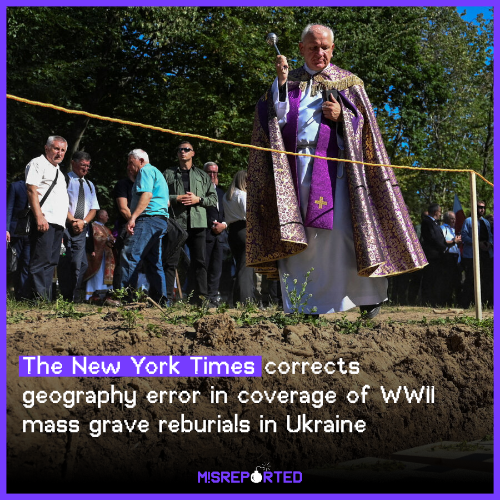
The New York Times corrects geography error in coverage of WWII mass grave reburials in Ukraine
The New York Times has amended its reporting on the reburial of World War II victims in Ukraine, after incorrectly placing the location of the mass graves in western Poland. They were in fact in western Ukraine.
In the context of a fraught historical dispute — one that has shaped nationalist narratives in both countries and remains a sensitive diplomatic issue — the difference between western Ukraine and western Poland is far from trivial.
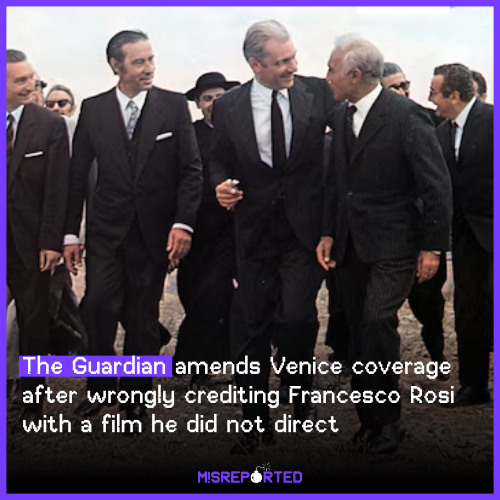
The Guardian amends Venice coverage after wrongly crediting Francesco Rosi with a film he did not direct
The Guardian has corrected two errors in its reporting on this year’s Venice Film Festival, acknowledging that Gianfranco Rosi — not the late Francesco Rosi — directed Below the Clouds, and that jury member Fernanda Torres’s first name was initially misspelled.
While the error may seem inconsequential — a slip between two directors sharing a surname — its resonance is wider.
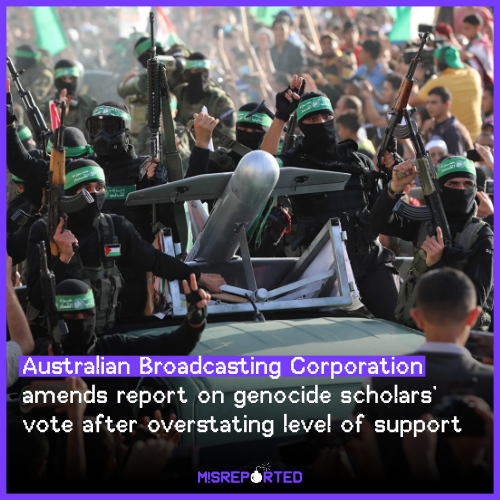
Australian Broadcasting Corporation amends report on genocide scholars’ vote after overstating level of support for Gaza resolution
ABC has issued a correction after multiple outlets — Radio News, News Channel and News Digital — mischaracterized the voting figures behind a resolution from the International Association of Genocide Scholars (IAGS) declaring Israeli actions in Gaza as genocide.
Initial reports on September 2 said a majority of the association’s 500 members had voted in favor of the resolution. In reality, participation was far lower. Only 28 percent of members took part in the ballot, of whom 86 percent voted in favor.
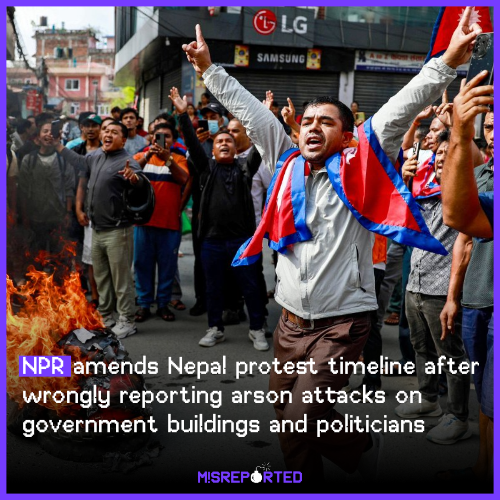
NPR amends Nepal protest timeline after wrongly reporting arson attacks on government buildings and politicians’
NPR has issued a correction to its coverage of the mass Gen Z protests in Nepal, acknowledging that arson attacks on government buildings and the homes of senior politicians took place on Tuesday, not Monday as initially reported.
The original article suggested that the most severe violence erupted on the very first day of demonstrations, when young Nepalis began protesting corruption and a government ban on social media platforms. That framing implied an immediate descent into destruction.
In fact, the first day’s unrest, while deadly, did not involve the torching of parliament, the Supreme Court, or the residences of political leaders.

FT amends police deployment figure in France protest coverage
The Financial Times has corrected a significant numerical error in its reporting on France’s political turmoil, acknowledging that 80,000 police officers were deployed for a day of nationwide protests on September 10, not 800,000 as originally stated. The mistake appeared in an article detailing President Emmanuel Macron’s appointment of Sébastien Lecornu as prime minister, following the ousting of François Bayrou in a confidence vote over his austerity program.

NYT corrects timeline on Russian propaganda warnings in Trump–Congress analysis
The New York Times has corrected an error in its recent news analysis on how the Trump administration has undermined Congress. The article originally stated that the Foreign Malign Influence Center (FMIC), established by Congress to counter election interference, played a major role warning about Russian propaganda during the 2020 presidential campaign. In fact, the FMIC only issued such warnings in 2024.

FT corrects telecoms oligopoly claim in SpaceX–EchoStar coverage
The Financial Times has issued a correction after misstating which companies make up the dominant trio in US telecoms. A Lex column published on September 9 erroneously included Sprint in the oligopoly of US mobile operators. The group in fact consists of AT&T, Verizon, and T-Mobile. The correction was appended to coverage of SpaceX’s $17bn spectrum deal with EchoStar, a transaction that has reshaped both companies’ prospects.
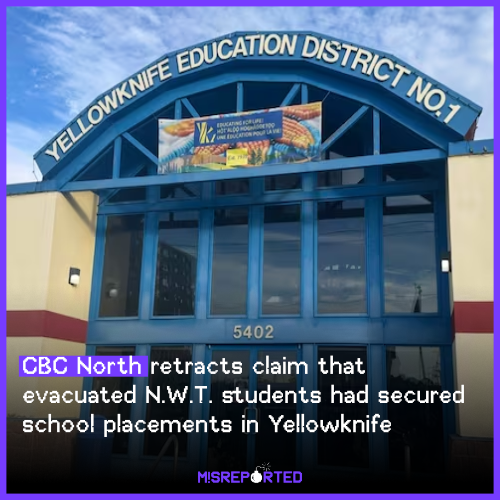
CBC North retracts claim that evacuated N.W.T. students had secured school placements in Yellowknife
CBC North has issued a correction after wrongly reporting that students from Whatì and Fort Providence, two communities evacuated due to wildfires, had already been accepted into Yellowknife schools. The clarification matters not only for accuracy but for the families caught in the uncertainty of displacement. The original story stated that students were continuing their education in Yellowknife Education District No. 1.
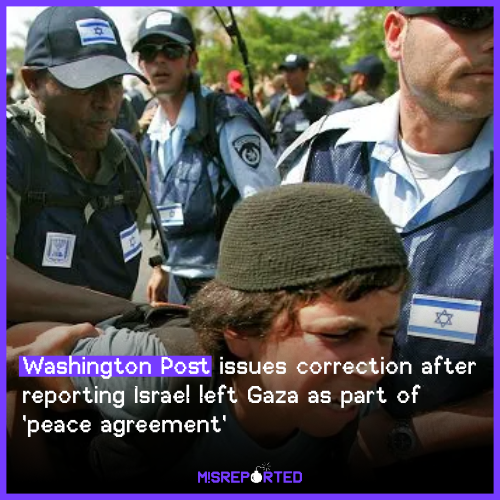
Washington Post issues correction after reporting Israel left Gaza as part of 'peace agreement'
The Washington Post’s correction this week, after it inaccurately described Israel’s 2005 withdrawal from Gaza as the outcome of a “peace agreement,” is more than a minor editorial slip. It touches on one of the most contested narratives in modern Middle Eastern politics, and in doing so illustrates the hazards faced by Western media in reporting on conflicts where precision is as politically charged as it is journalistic.