Ars Technica retracts AI story after fabricated quotes attributed to developer
Ars Technica retracted an article on an AI agent's attack on a developer after AI-generated quotes were attributed to him. What went wrong and why it matters.
Corrections in technology reporting, including AI-generated errors and fabricated quotes in journalism.
The New York Times added an editor's note after an AI tool's summary of Pierre Poilievre's views appeared in its Canada coverage as a direct quotation.
Ars Technica retracted an article on an AI agent's attack on a developer after AI-generated quotes were attributed to him. What went wrong and why it matters.
In its 16 December feature on the impact and costs of HS2 , The Guardian misreported several factual details, prompting corrections after publication.…
The Times corrected its headline after implying Europe’s electric vehicle market was slowing, despite the accompanying article indicating sales were still…
The Guardian corrected its reporting in a letters exchange on solar geoengineering, clarifying that a cited claim referred to a potential cooling of 1…
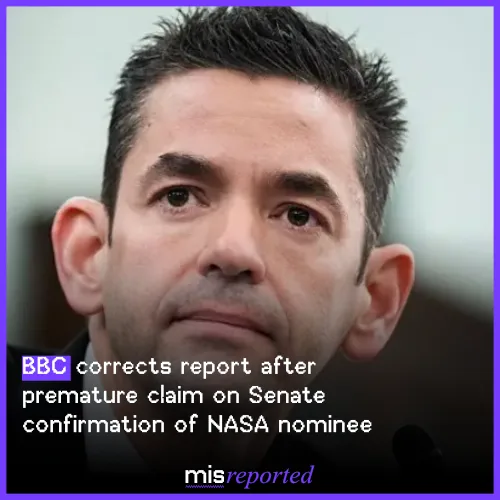
BBC corrected its reporting on Jared Isaacman’s appointment, clarifying that his nomination had only passed a procedural vote at the time, rather than…
The Financial Times corrected its reporting after stating that Uber drivers were not paid for time spent travelling to pick-up locations.
CNBC corrected its reporting on Nvidia’s response to allegations about Blackwell chips in China, clarifying that the company said it had seen no…
The New York Times corrected its reporting on a related security camera case, clarifying that Verkada’s nearly three million dollar payment was a civil…
The most consequential finding in the BBC–EBU study is not the headline figure that 45 per cent of AI-generated news answers contained significant flaws.…
Euractiv ’s opinion piece “Europe’s airspace chaos, the new commonplace” paints a dramatic picture of systemic aviation failure, citing drone incursions…
The Straits Times has clarified that 17,300 unmanned aircraft lacked digital licence plates at registration — about 64 per cent, not “more than 65 per…
The Wall Street Journal has clarified that OpenAI’s nonprofit parent retains ownership of its for-profit subsidiary, which has become a public-benefit…
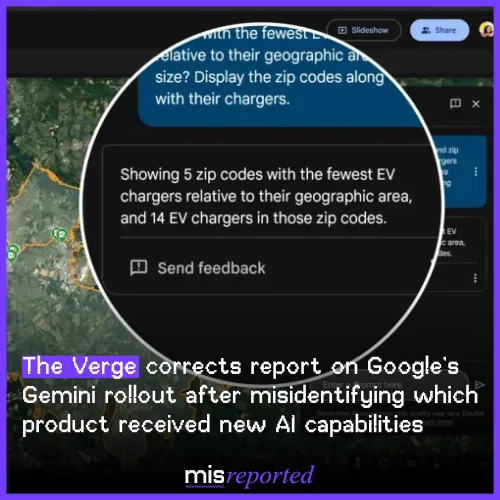
The Verge has clarified that Google’s Geospatial Reasoning framework — not Google Earth — is the product receiving new Gemini AI capabilities.
The New York Times has clarified that Chile’s government hopes to announce its northern data centre plan by the end of the year, not before next month’s…
The Times has corrected its reporting to note that RingGo is Swedish owned, not Swiss owned.
The Financial Times has amended its report to clarify that Alexander Antelme KC represents Renault, not Nissan, in the UK diesel emissions case.
The Financial Times has corrected its reporting to state that Max Enders of Germany’s Tytan Technologies, not Alex Roslin of Ukrainian drone maker Wild…
The Financial Times has issued a correction after misstating which companies make up the dominant trio in US telecoms. A Lex column published on September…