

Opinion: Misreporting no longer misleads. It destabilises.
One of the more striking features of 2025 has been the gap between events themselves and the way they have been experienced. Wars appeared perpetual, crises uncontainable, institutions either paralysed or rogue. Yet in many cases, underlying realities were more constrained than the coverage suggested. What created the sense of constant upheaval was not only what happened, but how quickly and incompletely it was reported.

The Times removes Gaza image after concerns over misleading context
The Times removed a Gaza photograph and deleted related text after concerns were raised that the material lacked essential medical and operational context.
The original presentation encouraged readers to interpret the image as evidence of conflict-related starvation and violence without accommodating verified alternative explanations.
That distinction matters, and misframing it risks undermining public trust, inflating narratives, or distorting accountability.

CNN corrects global health funding report after misstatement on US aid reductions
CNN corrected its reporting on polio eradication funding, clarifying that US aid for polio has not been definitively cut and that future funding levels remain uncertain rather than settled.
The original framing suggested a clearer withdrawal by the United States than the facts supported, materially shaping how readers would interpret the funding gap.
That distinction matters, and misframing it risks undermining public trust, inflating narratives, or distorting accountability.

The Guardian amends account of content in Sky Sports Halo TikTok coverage
The Guardian corrected its coverage of Sky Sports’ Halo TikTok channel, clarifying that a widely cited “Crashgate” post was not produced by Halo but was a parody from another account.
The original framing attributed that content to Halo, reinforcing impressions of sexism that were not fully supported by the channel’s actual output.
That distinction matters, and misframing it risks undermining public trust, inflating narratives, or distorting accountability.
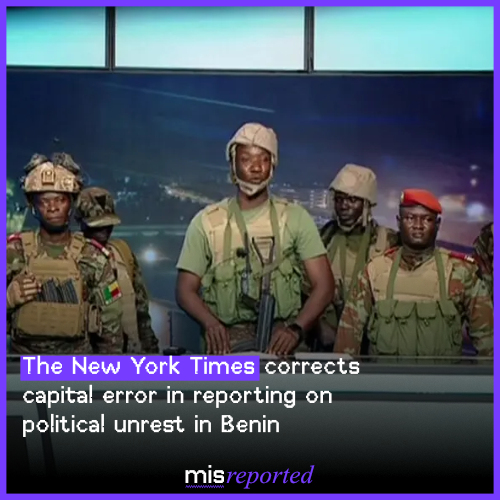
The New York Times corrects capital error in reporting on political unrest in Benin
The New York Times corrected its reporting on the attempted coup in Benin, clarifying that the country’s capital is Porto-Novo, not Cotonou.
The original framing reflected a rushed and assumption-driven approach to unfamiliar geographies, materially weakening how readers would understand the political context.
That distinction matters, and misframing it risks undermining public trust, reinforcing Western blind spots, or distorting accountability.
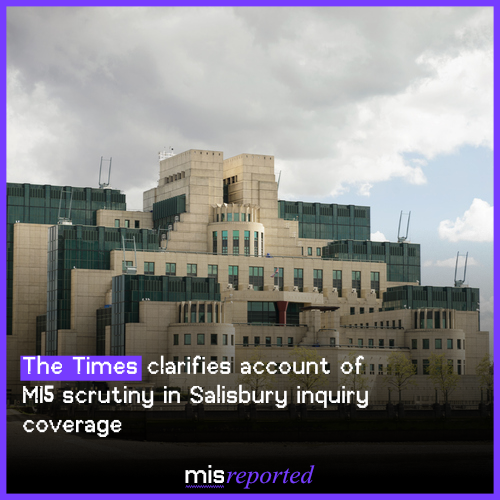
The Times clarifies account of MI5 scrutiny in Salisbury inquiry coverage
The Times corrected its reporting on the Salisbury poisoning inquiry, clarifying that the inquiry did not censure MI5 and found the attack could not have been prevented by additional security measures.
The original framing suggested that the security services were expected to face criticism, which materially altered how readers would assign responsibility and assess preventability.
That distinction matters, and misframing it risks undermining public trust, inflating narratives, or distorting accountability.

The Guardian corrects detail in coverage of Palestine Action proscription hearing
The Guardian corrected its reporting on the High Court case involving Palestine Action by amending a spelling error in a named individual’s details.
The original coverage prioritised immediacy and narrative framing, contributing to a compressed account that left key legal and contextual distinctions underdeveloped.
That distinction matters, and misframing it risks undermining public trust, inflating narratives, or distorting accountability.

Why everything felt more chaotic in 2025 than it actually was
Few years have felt as relentlessly unstable as 2025. Wars appeared to expand without warning, disasters seemed more frequent and more deadly, migration debates hardened overnight, and institutions struggled visibly under pressure. Yet in many cases, the underlying realities were less volatile than the coverage suggested. What made the year feel chaotic was not only what happened, but how it was reported.

The New York Times corrects description of Israeli conditions for reopening Gaza border crossing
The New York Times corrected its reporting on the reopening of the Rafah crossing, clarifying that Israel said it would be opened in both directions once the remains of the final captives believed to be held in Gaza are returned.
The original framing implied that Israel was restricting the crossing independently of ceasefire conditions, materially altering how readers would interpret responsibility for the delay.
That distinction matters, and misframing it risks undermining public trust, inflating narratives, or distorting accountability.

Opinion: Why Asia’s latest catastrophes exposed a media problem
In the immediate aftermath of a disaster, information becomes almost as critical as food, water or medical care. Yet it is precisely at these moments that reporting is most vulnerable to haste, distortion and premature certainty. Misreporting during catastrophic events does not merely mislead audiences; it risks undermining emergency response, public health decision-making and the fragile sense of control that authorities and communities are struggling to maintain.
Opinion: How media misreporting breeds international distrust
Foreign policy is rarely shaped by battlefield developments alone. It is shaped just as powerfully by how those developments are presented to distant audiences, stripped of legal architecture and strategic constraint. In this respect, the reporting of conflict is not a neutral relay of events but a quiet arbiter of legitimacy. When that reporting omits essential context, it can convert complexity into grievance, and grievance into durable mistrust.
The New York Times corrects legal characterization in report on hacked home cameras
The New York Times corrected its reporting on a related security camera case, clarifying that Verkada’s nearly three million dollar payment was a civil penalty agreed in a settlement, not a fine.
The original framing suggested a more punitive legal sanction than had occurred, materially altering how readers would interpret regulatory accountability in comparable cases.
That distinction matters, and misframing it risks undermining public trust, inflating narratives, or distorting accountability.

POLITICO corrects detail on rice producers in EU migration-trade agreement coverage
POLITICO corrected its reporting on the EU’s trade and migration agreement, removing erroneous references to specific rice-producing countries said to have threatened support for the deal.
The original framing attributed negotiating pressure to incorrectly identified actors, materially altering how readers would interpret the trade dynamics surrounding the agreement.
That distinction matters, and misframing it risks undermining public trust, inflating narratives, or distorting accountability.
Opinion: The policy cost of getting domestic violence statistics wrong
In coverage of domestic violence, precision is not a luxury. It is the difference between evidence-based policymaking and narratives built on quicksand. The recent correction by ABC News to a widely shared article on the statistical rarity of lethal family violence offers a reminder of how easily public understanding can slip when journalism falters on basic numerical accuracy. Errors of this kind do not merely distort a single story; they risk shaping an entire policy conversation around a false premise.

The Guardian amends location detail in coverage of undersea drone industry
The Guardian corrected its reporting on the location of a Helsing facility, clarifying that it is based in Plymouth rather than Portsmouth.
The original framing suggested a different geographic alignment with UK naval infrastructure, which materially altered how readers would interpret industrial clustering in the defence sector.
That distinction matters, and misframing it risks undermining public trust, inflating narratives, or distorting accountability.
IPSO ruling leads The Daily Telegraph to correct claim on serious sexual offence statistics in migration commentary
The Daily Telegraph corrected its reporting on serious sexual offence statistics in England and Wales following an IPSO ruling, clarifying that the fourfold increase occurred since 2013 rather than since 2015.
The original framing suggested a more recent and steeper rise than the data supported, materially altering how readers would interpret the scale and timing of the trend.
That distinction matters, and misframing it risks undermining public trust, inflating narratives, or distorting accountability.

BBC News corrects statement on coroner finding in Swindon death coverage
BBC News corrected its reporting on the death of Sarah Forrester, clarifying that no coroner’s ruling had been issued on the cause of death.
The original framing suggested that the coroner had already found the death to be inconclusive, which materially altered how readers would interpret the stage and status of the investigation.
That distinction matters, and misframing it risks undermining public trust, inflating narratives, or distorting accountability.

BBC News clarifies description of Elon Musk-linked lottery during US election coverage
BBC corrected its reporting on Elon Musk’s election-linked lottery activity, clarifying that eligibility was based on voter registration and signing a petition rather than voting Republican.
The original framing suggested that individuals were offered money in exchange for partisan votes, which materially altered how readers would interpret the issue.
That distinction matters, and misframing it risks undermining public trust, inflating narratives, or distorting accountability.
Opinion: The Birth Rate Crisis Is Being Misreported - And Everyone’s Falling for It
Few subjects attract more confident conclusions than falling birth rates. They are routinely framed as evidence of political neglect, social breakdown or inadequate family policy. The prescription follows quickly: expand parental leave, subsidise childcare, adjust tax credits. The logic is familiar, and reassuring. If governments act decisively, the numbers will recover.

Financial Times corrects judges named in Palestine Action proscription challenge
The Financial Times corrected an error identifying the judges assigned to hear the High Court challenge to the government’s proscription of Palestine Action.
While procedural, the mistake mattered in a case where judicial composition shapes expectations about how counterterrorism powers and protest rights will be tested.
The correction underlines how even small inaccuracies in legally sensitive reporting can erode confidence in coverage of contested political issues.